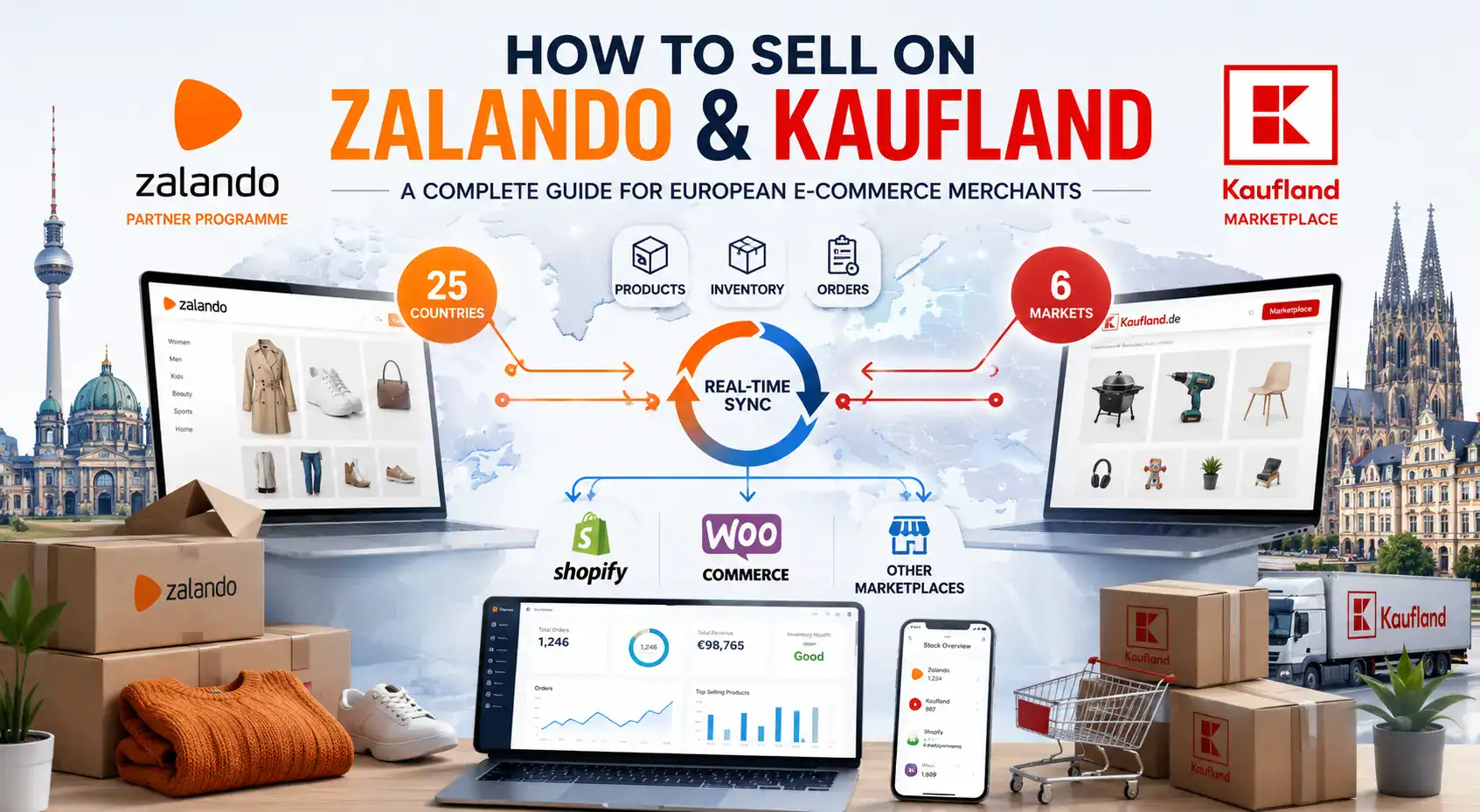
| TL;DR Zalando has 50+ million active customers across 25 European markets – but access requires an application, brand approval, and strict content standards. Kaufland Marketplace covers Germany, Austria, Czech Republic, Slovakia, Poland, and Romania, with 35+ million monthly visitors and relatively low competition in many categories.Both platforms use API-based connections, not product feeds – setup is done through an integration wizard, not a CSV upload.Zalando’s data quality requirements are among the strictest of any European marketplace: images, product descriptions, and size guides must meet publisher-level standards. Running Zalando and Kaufland alongside your own store requires automated inventory and order sync – manual management becomes unsustainable above 50 orders per day. |
Two of Europe’s fastest-growing marketplaces sit at opposite ends of the onboarding spectrum. Zalando is a premium fashion and lifestyle platform with 50+ million active customers across 25 countries – but getting access requires a formal application, brand review, and a commitment to content standards that most marketplaces do not demand. Kaufland Marketplace, by contrast, is an open-application general marketplace covering six Central European markets with over 35 million monthly visitors and a product mix ranging from electronics to garden furniture.
For European merchants, both represent significant revenue opportunities that most competitors have not yet fully exploited. This guide walks through what each platform requires, where the differences lie, and how to build a workflow that lets you manage both channels alongside your existing store without doubling your operational workload.
(more…) Continue reading →
Amazon is the world’s largest online marketplace, with over 300 million active customer accounts globally and annual third-party seller revenue exceeding $140 billion. For European merchants, selling on Amazon is not just a growth option – it is increasingly a baseline expectation in competitive product categories.
The good news: the barriers to entry are lower than most sellers expect. You do not need a US legal entity, a US bank account, or a dedicated development team to get started. What you do need is a clear understanding of how Amazon’s seller infrastructure works, what product data requirements you must meet, and how to keep your inventory and orders in sync across channels once you are live.
This guide covers everything a European merchant needs to know before listing their first product on Amazon – from account setup and VAT obligations through to product attributes, common errors, and multi-channel order management.
| Key Takeaways European merchants sell via Seller Central using a pan-European or individual marketplace account – no US entity required. Amazon Vendor Central is an invite-only wholesale programme; most independent merchants use Seller Central. Each Amazon marketplace has specific product attribute requirements – what works on amazon.de may need adjustment for amazon.fr or amazon.nl. VAT compliance is the most overlooked cost for new Amazon sellers expanding across EU countries. Automating inventory and order sync between your existing store and Amazon prevents overselling and reduces manual workload significantly. |
Pricing and features verified as of June 2026, based on koongo.com/pricing, datafeedwatch.com/pricing, and independent user reviews on G2, Capterra, and Tekpon.
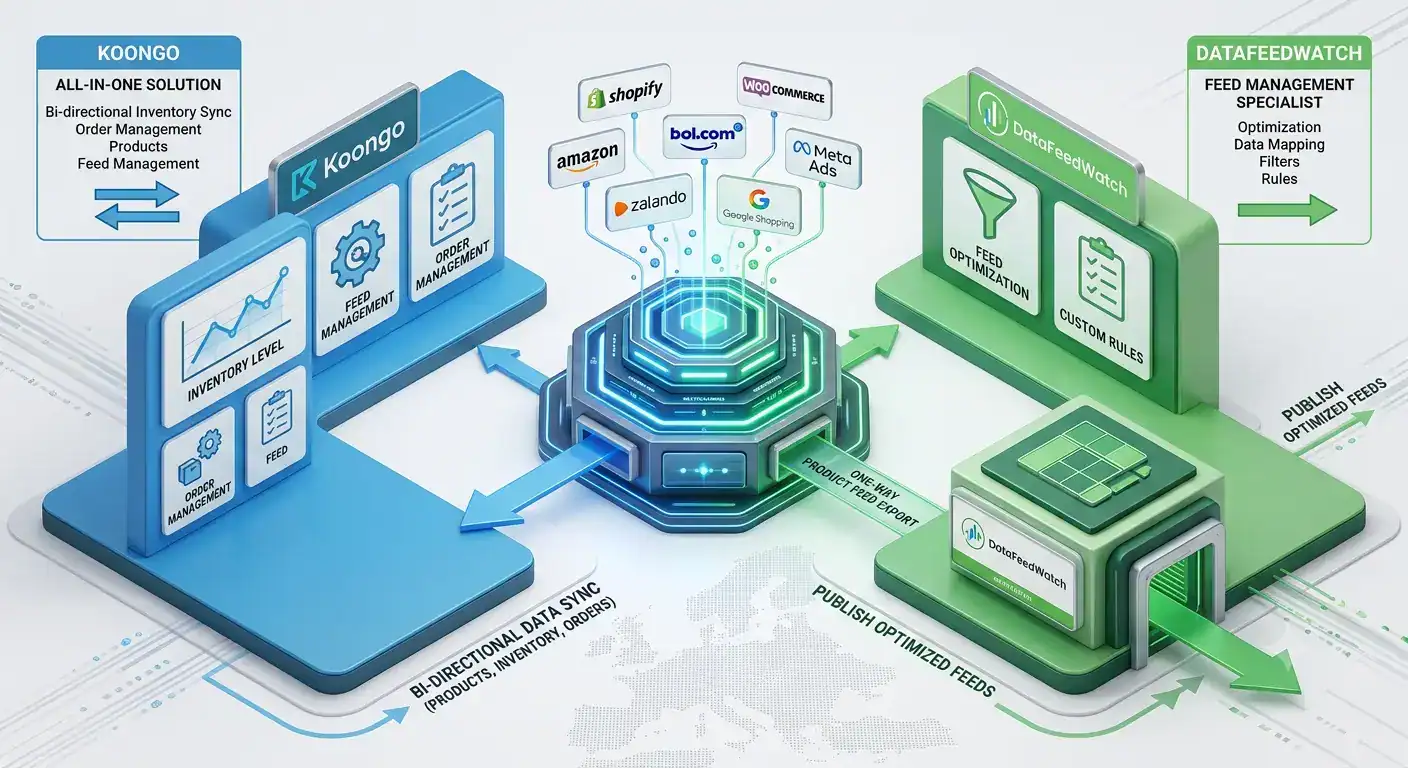
| TL;DR The main difference is feed management vs marketplace management: DataFeedWatch focuses on feed optimisation for advertising channels, while Koongo combines feed management with marketplace API integration, order sync, and inventory sync. Koongo offers a permanent Free Plan and paid plans from EUR 12/month with a 7-day free trial – no credit card required. Feed Manager is included in every plan as standard. Marketplace Manager is an add-on service and combining both costs the same as Marketplace Manager alone. DataFeedWatch’s plans start at EUR 54/month for the Shop tier, with no permanent free plan. Koongo’s marketplace order and inventory synchronization – and its bol.com Silver Partner status – are key differentiators for merchants selling directly on marketplaces, not just running ad feeds. DataFeedWatch’s larger channel library (2,000+ across 60+ countries) suits agencies focused purely on advertising feed optimisation. |
If you are comparing product feed tools, the decision usually comes down to one core distinction: feed management vs marketplace management. Feed management tools optimise and distribute your product data to advertising and comparison channels like Google Shopping or Meta Ads. Marketplace management goes further – it connects your store directly to marketplaces like Amazon, bol.com, or Zalando, syncing not just product listings but also inventory and orders.
This comparison is for merchants evaluating Koongo Pricing against DataFeedWatch as a DataFeedWatch alternative – particularly those selling on multiple marketplaces and channels from Shopify, WooCommerce, or Magento. DataFeedWatch is built primarily for feed management. Koongo combines feed management and marketplace integration software in one platform, which matters most if your roadmap includes direct marketplace selling rather than advertising feeds alone.
Below, we compare pricing, features, marketplace coverage, ease of use, and real costs for a sample store, so you can see which platform fits your specific situation.
(more…) Continue reading →
A new marketplace, easyShop, is launching for peak season 2026, and if you already sell on OnBuy you’re closer to being on it than you might think. The reason is OnCommerce: the platform that connects OnBuy, easyShop, and the returning Comet brand, letting sellers reach all three through a single account and a single product catalogue.
But what exactly is OnCommerce, how does the one-account model work, and what does each marketplace offer a seller? This guide breaks it down in plain terms: what OnCommerce is, the three marketplaces it powers, how listings, stock, and payments stay in sync across them, and the early-bird offer that gives you 12 months of subscription free if you join by 31 July 2026. We also cover how to connect your store to all three with Koongo, with no coding required.
(more…) Continue reading →