How AI Assistants Can Help Manage Marketplace Integrations
Selling on multiple marketplaces means managing different product requirements, category structures, account connections, listing settings, and order workflows.
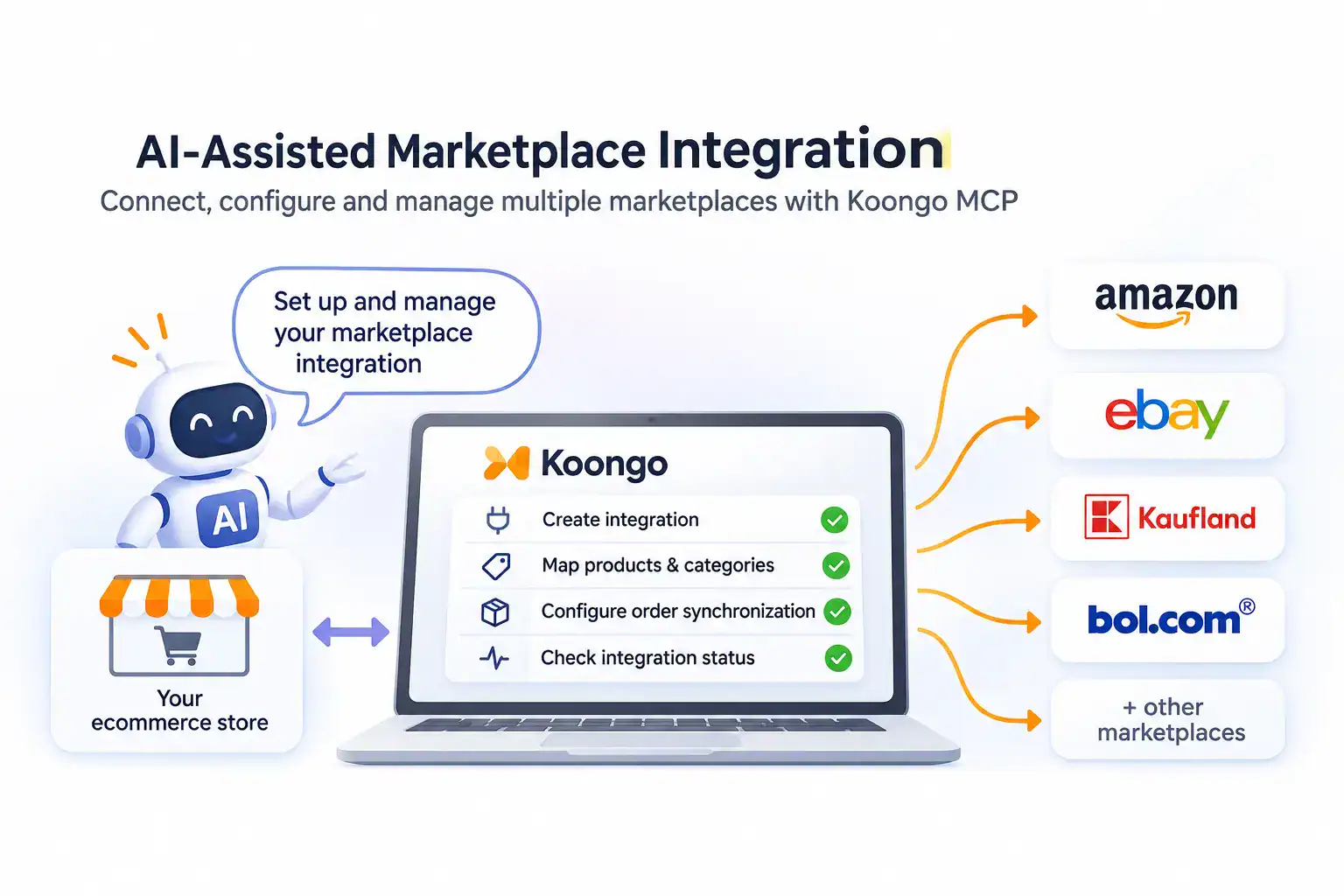
AI assistants can make this process easier by connecting directly to ecommerce tools through the Model Context Protocol (MCP).
With Koongo MCP, compatible AI assistants can work with supported Koongo marketplace integration tools using natural-language instructions.
You can ask an AI assistant to create a marketplace integration, guide you through its setup, help with product and category mappings, configure supported order synchronization, and check the integration status.
This guide explains how AI-assisted marketplace integration works and how Koongo MCP can help merchants connect and manage marketplaces such as Amazon, eBay, Kaufland, bol.com, and other supported sales channels.
TL;DR: Key Takeaways
Koongo MCP allows compatible AI assistants to work with supported marketplace integration tools through natural-language instructions.
An AI assistant can help create an integration and guide merchants through the Koongo marketplace setup process step by step.
The workflow can include identifiers, offer settings, product filters, category mapping, attribute mapping, connection, and final configuration.
Marketplace account authorization still needs to be completed by the merchant where login or OAuth access is required.
For supported marketplaces, Koongo can synchronize marketplace orders with the connected ecommerce store.
Merchants can use MANUAL product mode when testing an integration before publishing products more broadly.
AI-assisted marketplace integration uses an AI assistant to help connect, configure, and manage the systems that link an ecommerce store with online marketplaces.
A marketplace integration connects product and operational data between your ecommerce store and a marketplace such as Amazon, eBay, Kaufland, or bol.com.
Depending on the marketplace and integration, this can involve:
product listings,
product identifiers,
prices and availability,
product filters,
category mapping,
attribute mapping,
marketplace account authorization,
order synchronization.
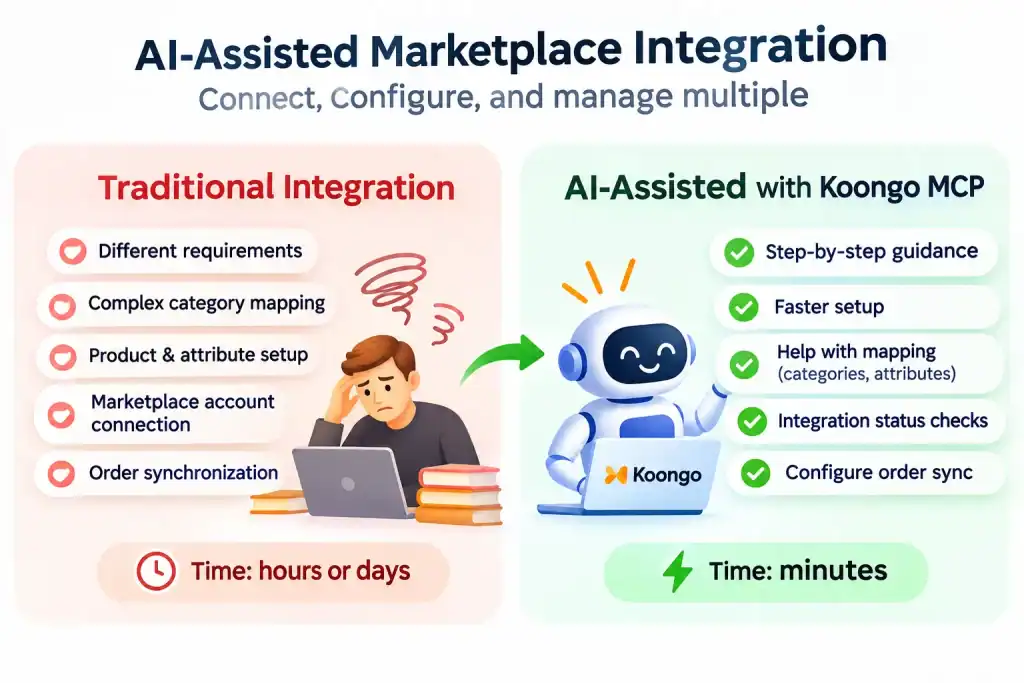
Traditionally, merchants configure these elements through dashboards, settings, and integration wizards.
With MCP, a compatible AI assistant can interact with the tools exposed by the ecommerce integration platform. This adds a conversational way to work through supported marketplace integration tasks.
obrazok
Why Marketplace Integrations Get Complicated
Connecting a store to a marketplace involves more than transferring a list of products.
Each marketplace can have its own product requirements, category taxonomy, identifiers, required attributes, listing rules, account authorization process, and order capabilities.
A merchant selling through several marketplaces may therefore need to manage different configurations for each destination.
Integration Area
What Can Differ Between Marketplaces
Product identifiers
SKU, GTIN, EAN, marketplace-specific identifiers
Categories
Each marketplace can use its own product taxonomy
Attributes
Different required fields and accepted values
Listings
Different product and offer requirements
Orders
Order synchronization capabilities vary by marketplace
This is why marketplace integration platforms such as Koongo provide a layer between the ecommerce store and individual marketplaces.
MCP adds another layer on top of that infrastructure by allowing compatible AI assistants to work with supported integration tools conversationally.
How Koongo MCP Works with Marketplace Integrations
Koongo MCP gives compatible AI assistants access to supported Koongo marketplace tools and project context.
Instead of finding every configuration screen yourself, you can describe the marketplace task you want to complete.
For example:
I want to add an Amazon marketplace integration. Walk me through it one step at a time, and don’t activate anything until I say so.
The assistant can create the integration, read the required setup steps, and guide you through the marketplace wizard in the required order.
A simplified workflow looks like this:
Ecommerce Store → Koongo → Marketplace Integration → Marketplace
Koongo MCP gives the AI assistant a conversational interface to supported parts of this workflow.
1. Choose a Marketplace
The first step is selecting the marketplace you want to connect.
Through Koongo MCP, you can ask which marketplace channels are available for your project and select the appropriate integration.
For example:
Which marketplaces can I add for my catalogue?
Or, if you already know the destination:
I want to add an eBay marketplace integration.
If a channel provides multiple integration options or variants, the assistant can help you work through the available choices before creating the integration.
2. Create the Marketplace Integration
After selecting the marketplace, the AI assistant can create the integration in Koongo and retrieve the steps required by its setup wizard.
The exact steps depend on the marketplace, but the workflow can include:
product identifiers,
offer settings,
product filters,
marketplace connection,
category mapping,
attribute mapping,
order settings where supported,
final summary and activation.
The assistant works through the available wizard steps in their required order.
This means the merchant can focus on the desired configuration while the assistant helps navigate the underlying setup process.
3. Configure Products and Listings
Once the integration exists, the next step is determining how products should be handled on the marketplace.
This can include selecting identifiers, configuring offer settings, and filtering which products should be included in the integration.
For example, you might want to sell only a specific part of your catalogue:
Only include products that are currently in stock.
Or you may need to define how products and variants are identified.
Correct identifiers are important because marketplaces use them to match products, offers, variants, stock, and updates.
The available settings depend on the selected marketplace and the type of integration being configured.
4. Map Categories and Attributes
Marketplace product data needs to match the requirements of the destination channel.
This often involves two important steps: category mapping and attribute mapping.
Category mapping
Your ecommerce store and the marketplace may organize products differently.
Category mapping connects your store categories with the appropriate categories in the marketplace taxonomy.
You can ask:
Which categories still need to be mapped for this marketplace?
Attribute mapping
Marketplaces can also require product attributes such as brand, GTIN, colour, size, material, or other category-specific information.
The assistant can help identify unresolved required attributes and work with supported mappings.
Show me which required attributes are still missing.
Category selection can affect which attributes become required, so these steps often work together.
Marketplace integration usually requires authorization between Koongo and your marketplace account.
This is one part of the workflow the AI assistant does not complete on your behalf.
When the marketplace connection step is reached, the assistant can provide the appropriate authorization or settings link. You then complete the login or authorization process in your browser.
After you finish, the assistant can continue with the integration and check the connection status.
Your marketplace credentials remain part of the marketplace authorization process rather than something you provide directly to the AI assistant.
6. Test Before Publishing Products
Testing is particularly important when creating a new marketplace integration.
Completing an integration can activate it, and product mode determines how matching products are handled.
Koongo MCP supports a MANUAL product mode that can be useful during testing.
For example:
Set this marketplace to MANUAL mode, publish just one product so I can check it, and don’t activate everything yet.
This allows the merchant to inspect a limited test before releasing a larger set of products to the live marketplace.
Once the listing and configuration have been checked, the merchant can decide when to continue with broader activation.
obrazok
7. Configure Marketplace Order Synchronization
Marketplace integrations can involve data moving in both directions.
Products, prices, and availability move toward the marketplace, while marketplace orders can flow back into the merchant’s ecommerce store when the channel and store platform support order synchronization.
With Koongo MCP, the AI assistant can check whether order synchronization is available for the selected marketplace.
If supported, you can ask:
Turn on order sync for my marketplace, help me configure the order settings, then start syncing.
The setup involves enabling the order synchronization capability, configuring the required order settings, and then starting synchronization.
These are separate actions. Enabling the capability alone does not automatically start order synchronization.
Once configured, supported marketplace orders can be synchronized back to the connected ecommerce store.
obrazok
Example: Setting Up a Marketplace with AI
Let’s put the workflow together using a new marketplace integration as an example.
Step 1: Select the marketplace
I want to add an Amazon marketplace integration.
Step 2: Create the integration
The assistant creates the integration and retrieves the required setup steps.
Step 3: Configure the marketplace settings
Work through identifiers, offer settings, product filters, and other available configuration steps.
Step 4: Complete marketplace authorization
When the connection step appears, complete the required login or authorization in your browser.
Step 5: Map categories and attributes
Show me which categories and required attributes still need attention.
Step 6: Test the integration
Set the marketplace to MANUAL mode and let me test one product first.
Step 7: Configure orders where supported
Check whether order synchronization is supported and help me configure it.
The exact configuration varies by marketplace, but the principle remains the same: the merchant describes the desired outcome while the AI assistant works with the supported Koongo integration tools.
AI-Assisted vs Traditional Marketplace Integration
Task
Traditional Workflow
AI-Assisted Workflow with Koongo MCP
Select marketplace
Browse available integrations
Ask which marketplace integrations are available
Create integration
Start and navigate the setup wizard
Ask the assistant to create the integration and guide you through it
Product settings
Configure identifiers, filters, and offer settings through the interface
Describe the desired configuration conversationally
Category and attribute mapping
Inspect requirements and configure mappings
Ask which mappings remain unresolved and work through them
Account connection
Complete marketplace authorization
The assistant provides the connection step, while you complete authorization in the browser
Testing
Configure product publishing settings manually
Ask the assistant to use MANUAL mode and test a limited product set
Order synchronization
Find and configure order settings
Ask the assistant to check support, configure settings, and start synchronization
Where AI Helps Most with Marketplace Integrations
The biggest advantage of AI-assisted marketplace management is reducing the gap between what a merchant wants to accomplish and where that configuration exists in the integration software.
Instead of starting with a dashboard, merchants can start with an outcome:
Add eBay Germany and stop before the connection step.
Which categories still need to be mapped?
Check whether order synchronization is available for this marketplace.
The underlying marketplace requirements still apply. AI does not remove channel rules, account authorization, required product data, or marketplace-specific limitations.
It provides another way to work with the integration tools that manage those requirements.
AI Does Not Remove the Need for Marketplace Control
Marketplace integrations can affect live product listings, prices, stock, and orders, so merchants should understand what will happen before activating changes.
Koongo MCP allows merchants to work step by step and use MANUAL product mode when testing new integrations.
For important changes, merchants can ask the assistant to explain what it is about to do before proceeding.
Before you activate anything, show me what you’re about to do.
This is especially useful when setting up a new marketplace or changing an existing live integration.
Frequently Asked Questions
Can AI connect my ecommerce store to a marketplace?
AI can assist with the integration process when connected to a platform that exposes the required tools. With Koongo MCP, a compatible AI assistant can help create and configure supported marketplace integrations and guide the merchant through the required setup steps.
Can Koongo MCP create a marketplace integration?
Yes. Koongo MCP can create supported marketplace integrations and guide merchants through the available setup wizard, including product settings, filters, category mapping, attribute mapping, and other required steps.
Can AI log in to my marketplace account for me?
No. When marketplace authorization is required, the merchant completes the login or authorization process in the browser. The assistant can provide the relevant connection step and continue after the connection has been completed.
Can AI help map marketplace categories and attributes?
Yes. Koongo MCP can help identify unresolved category and attribute mappings and work with supported mapping tools during marketplace configuration.
Can I test a marketplace integration before publishing all products?
Yes. Koongo supports MANUAL product mode for controlled testing. Merchants can use it to test a limited product before moving toward broader activation.
Can Koongo synchronize marketplace orders?
Koongo supports order synchronization for selected marketplaces and ecommerce platforms. Through Koongo MCP, the assistant can check whether order synchronization is available for the selected integration and help configure and start it.
Does AI replace marketplace integration software?
No. Marketplace integration still depends on the infrastructure that connects the ecommerce store with each marketplace. Koongo provides that integration layer, while MCP gives compatible AI assistants a conversational way to work with supported Koongo tools.
Conclusion
Marketplace integrations involve product data, listing settings, categories, attributes, account connections, testing, and in many cases order synchronization.
Koongo MCP allows compatible AI assistants to work with supported marketplace integration tools using natural-language instructions.
Merchants can use an AI assistant to create an integration, work through its setup, configure product requirements, map categories and attributes, test products, and manage supported order synchronization.
The marketplace rules and integration infrastructure remain the same. MCP changes how merchants can interact with them.
Instead of navigating every marketplace integration task manually, merchants can increasingly start by describing what they want to accomplish.
Koongo uses cookies to improve your experience. By clicking “Accept”, you consent to the use of ALL the cookies. However, you may visit Cookie Settings to provide controlled consent. Cookie settingsACCEPT
Cookies
Privacy Overview
Koongo uses cookies to improve your experience while you navigate through the website. These cookies will be stored in your browser only with your consent. Learn more
Necessary cookies are absolutely essential for the website to function properly. This category only includes cookies that ensure the basic functionalities and security features of the website. These cookies do not store any personal information.
Cookie
Type
Duration
Description
_GRECAPTCHA
1
5 months 27 days
This cookie is set by Google. In addition to certain standard Google cookies, reCAPTCHA sets a necessary cookie (_GRECAPTCHA) when executed for the purpose of providing its risk analysis.
cli_user_preference
persistent
11 months
Set by the GDPR Cookie Consent plugin. Stores the visitor’s cookie preferences per category and language. It does not store any personal data.
cookielawinfo-checkbox-advertisement
1
1 year
The cookie is set by GDPR cookie consent to record the user consent for the cookies in the category "Advertisement".
cookielawinfo-checkbox-analytics
1
1 year
This cookies is set by GDPR Cookie Consent WordPress Plugin. The cookie is used to remember the user consent for the cookies under the category "Analytics".
cookielawinfo-checkbox-live-chat
1
1 year
No description
cookielawinfo-checkbox-necessary
0
11 months
This cookie is set by GDPR Cookie Consent plugin. The cookies is used to store the user consent for the cookies in the category "Necessary".
cookielawinfo-checkbox-non-necessary
0
11 months
This cookie is set by GDPR Cookie Consent plugin. The cookies is used to store the user consent for the cookies in the category "Non Necessary".
cookielawinfo-checkbox-performance
1
1 year
This cookie is set by GDPR Cookie Consent plugin. The cookie is used to store the user consent for the cookies in the category "Performance".
CookieLawInfoConsent
persistent
11 months
Set by the GDPR Cookie Consent plugin. Records the visitor’s consent choices for each cookie category. It does not store any personal data.
gr
1
90 days
This cookie is used by Reditus Affiliate system. Reditus does not build a tracking profile - learn more.
intercom-device-id-tctfy2ty
persistent
9 months
First party cookie is set by Intercom for Messenger. Used to identify the device interacting with the Messenger in order to improve security.
intercom-id-tctfy2ty
persistent
9 months
First party cookie is set by Intercom for Messenger. Anonymous visitor identifier cookie. Allows visitors to see any conversations they've had on Koongo websites.
intercom-session-tctfy2ty
session
7 days
First party cookie is set by Intercom for Messenger. Allows users to access their conversations and have data communicated on logged out pages for 1 week. Identifier for each unique browser session. This session cookie is refreshed on each successful logged-in ping, extending it one week from that moment.
language
0
1 week
Cookie for the language selector on the website.
viewed_cookie_policy
0
11 months
The cookie is set by the GDPR Cookie Consent plugin and is used to store whether or not user has consented to the use of cookies. It does not store any personal data.
We use these cookies to allow live-chat on the website.
Cookie
Type
Duration
Description
__cfruid
1
session
This cookie is set by the provider Cloudflare. This cookie is used for load balancing and for identifying trusted web traffic.
AWSALBCORS
1
7 days
This cookie is used for load balancing services provded by Amazon inorder to optimize the user experience. Amazon has updated the ALB and CLB so that customers can continue to use the CORS request with stickness.
Analytical cookies are used to understand how visitors interact with the website. These cookies help provide information on metrics the number of visitors, bounce rate, traffic source, etc.
Cookie
Type
Duration
Description
_ga
0
2 years
This cookie is installed by Google Analytics. The cookie is used to calculate visitor, session, camapign data and keep track of site usage for the site's analytics report. The cookies store information anonymously and assigns a randoly generated number to identify unique visitors.
_ga_E34740YP54
persistent
2 years
Set by Google Analytics 4. Used to persist the session state and count page views for the GA4 property (measuremSet by Google Analytics 4. Used to persist the session state and count page views for the GA4 property (measurement ID G-E34740YP54).ent ID G-E34740YP54).
_gat
0
1 minute
This cookies is installed by Google Universal Analytics to throttle the request rate to limit the colllection of data on high traffic sites.
_gid
0
1 day
This cookie is installed by Google Analytics. The cookie is used to store information of how visitors use a website and helps in creating an analytics report of how the wbsite is doing. The data collected including the number visitors, the source where they have come from, and the pages viisted in an anonymous form.
_uv_id
session
2 years
The cookie is set by Google Analytics. The cookie is used to collects data on the user’s visits to the website, such as which pages have been read.
SL_C_23361dd035530_SID
0
2 years
This cookie is installed by Smartlook. The cookie contains the project key, session ID, and visitor ID. Session and visitor IDs are unique identifiers assigned to new sessions and visitors.
UIDR
0
1 year
This cookie is set bu scorecardresearch.com. The cookie is used to tracks the users activity across the internet on the browser such as visit timestamp, IP address, and most recently visited webpages. and may the data send to 3rd party for analysis and reporting to help their clients better understand user preferences.
Advertisement cookies are used to provide visitors with relevant ads and marketing campaigns. These cookies track visitors across websites and collect information to provide customized ads.
Cookie
Type
Duration
Description
__oaiq_consent
persistent
1 year
Set by the OpenAI Ads Pixel (ChatGPT Ads). Stores the visitor's measurement consent state for the pixel.
__obref
persistent
1 year
Set by the OpenAI Ads Pixel (ChatGPT Ads). Stores a random browser identifier used to measure conversions from ChatGPT ads.
__oppref
persistent
30 days
Set by the OpenAI Ads Pixel (ChatGPT Ads). Stores the ad click reference from the landing URL to attribute conversions to ChatGPT ads.
_gcl_au
persistent
3 months
Used by Google AdSense for experimenting with advertisement efficiency across websites using their services
_uetsid
persistent
1 day
Set by Microsoft Advertising (Bing Ads) Universal Event Tracking. Stores a session ID to attribute conversions to ad clicks.
_uetvid
persistent
13 months
Set by Microsoft Advertising Universal Event Tracking. Stores a unique visitor ID to recognise returning visitors for conversion tracking.
IDE
persistent
1 year
This cookie is set by Doubleclick and carries out information about how the end user uses the website and any advertising that the end user may have seen before visiting the said website.
NID
1
6 months
This cookie is used to a profile based on user's interest and display personalized ads to the users.
test_cookie
session
11 months
The cookie is used to check if the user’s browser supports cookies.
uid
0
1 year
This cookie is used to measure the number and behavior of the visitors to the website anonymously. The data includes the number of visits, average duration of the visit on the website, pages visited, etc. for the purpose of better understanding user preferences for targeted advertisments.