

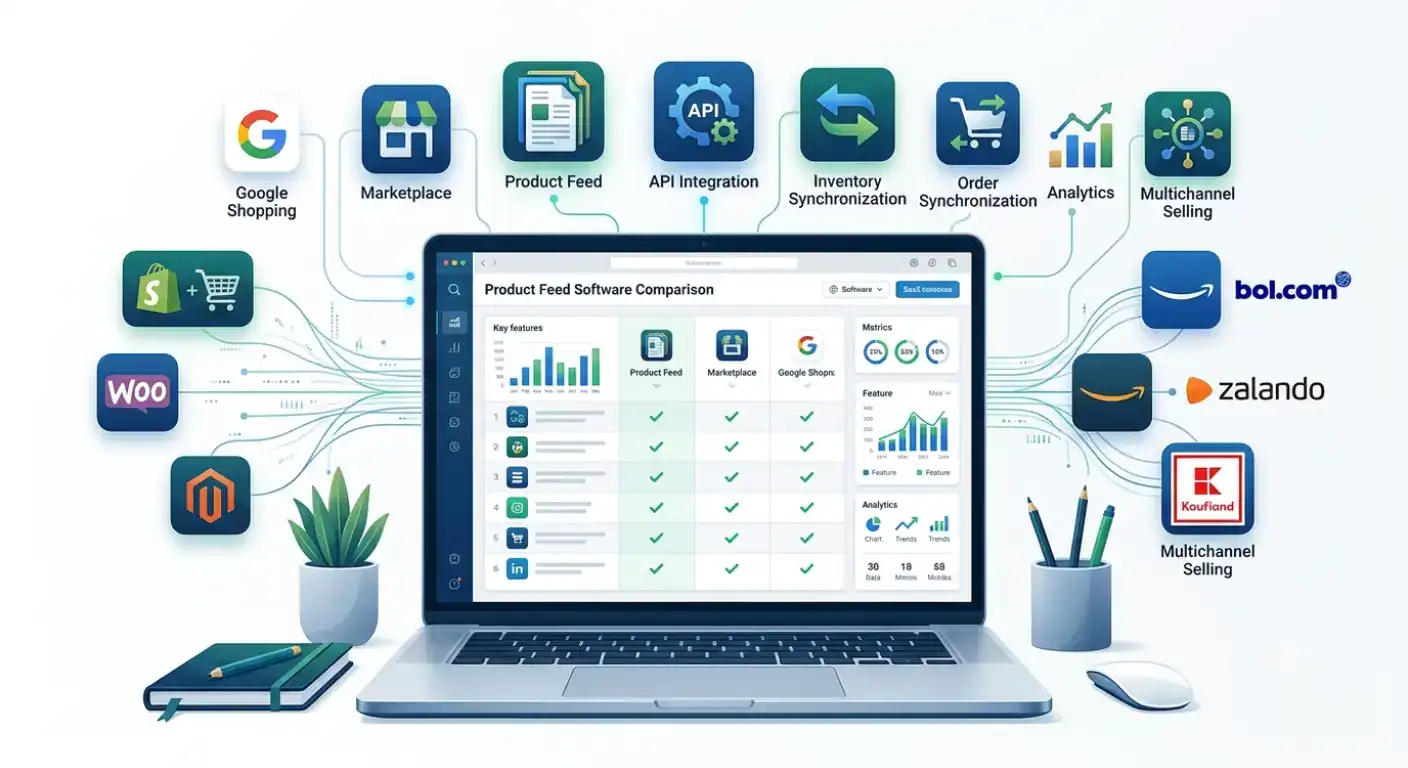
This comparison is based on publicly available product information, pricing pages, and user reviews as of mid-2026. Prices and features change. Verify with each vendor before purchasing.
If you run more than two advertising channels or list on any marketplace, you almost certainly need product feed software. Without it, you are manually reformatting the same product data for Google Merchant Center, Meta Commerce Manager, Idealo, and every marketplace where you sell, which is both time-consuming and error-prone.
Product feed software eliminates that work. It connects to your store, applies transformation rules to match each channel’s requirements, and distributes your catalog automatically on a schedule. The question is which tool fits your specific combination of channels, store platform, team size, and budget.
This guide compares six tools across the features that actually matter for the decision: channel coverage, marketplace depth, pricing structure, ease of setup, and who each tool is genuinely best for.
Obsah
- What is product feed software?
- Product feed software comparison: all tools at a glance (2026)
- How does pricing compare across product feed tools?
- How do the features compare across product feed tools?
- Product feed tool profiles: what each platform is actually good at
- Koongo: best for European SMBs who need feed and marketplace management combined
- Channable: best for agencies and merchants needing the widest channel coverage
- DataFeedWatch: best for SMBs and agencies focused on advertising feed optimisation
- GoDataFeed: best for budget-conscious merchants focused on Google and Amazon
- Feedonomics: best for large retailers who want a fully managed service
- Pros and cons: quick reference for all six tools
- Who should choose which product feed software?
- Frequently Asked Questions
- What is the difference between feed management software and marketplace integration software?
- Which product feed software is cheapest for a small store?
- Does product feed software work with Shopify and WooCommerce?
- How many channels does product feed software typically support?
- Do I need product feed software if I already use Shopify’s built-in Google Shopping integration?
- What is the setup time for product feed software?
- Can product feed software prevent Google Shopping disapprovals?
What is product feed software?
Product feed software is a platform that connects your e-commerce store’s product catalog to advertising channels and marketplaces, automatically transforming and formatting your product data to meet each channel’s specific requirements. It handles field mapping, attribute rules, filtering, and scheduled distribution, so you don’t maintain separate data files per channel manually.
A product feed is a structured file, typically XML, CSV, or JSON, containing your product data: titles, descriptions, prices, images, GTINs, and any channel-specific attributes. Every channel requires this data in a different format. Google Shopping needs a specific title structure; Meta has different image requirements; Amazon requires GTINs in a particular schema; Idealo expects a price format that differs from Beslist.
Without feed software, you maintain all of this manually: exporting from your store, reformatting in a spreadsheet, uploading to each channel. At three or more channels, this is a full day of work every time a product changes. At ten channels, it is unmanageable.
| What product feed software actually does Connects to your store (Shopify, WooCommerce, Magento, etc.) as the single source of truth for all product data Applies IF/THEN transformation rules to reformat attributes per channel, e.g. prepend brand to title for Google, truncate description to 500 characters for MetaFilters your catalog by product group, margin, stock level, or any attribute to control which products appear on which channelSchedules automatic feed updates (every 5 minutes, hourly, or daily) so channels always receive current pricing and stock dataValidates the feed before submission, flagging missing GTINs, oversized images, or required fields before the channel rejects themDistributes the formatted feed to each channel via feed URL or FTP, no manual uploads required. |
Important distinction: feed software handles one-way data distribution to advertising and comparison channels. It is different from marketplace integration software, which uses API connections to also import orders and synchronize inventory in real time. Some tools, including Koongo, combine both in one platform.
Product feed software comparison: all tools at a glance (2026)
The six tools in this comparison cover every market segment from small merchants running their first Google Shopping feed to enterprise retailers managing millions of SKUs across global channels. The key differentiators are pricing structure, whether marketplace order sync is included, and how much setup the tool requires.
| Tool | Starting price | Free plan | Marketplace sync | Channel library | Best for |
| Koongo | EUR 12/month | Yes | Yes, full API | 500+ channels | European SMBs needing feed + marketplace in one |
| Channable | EUR 49/month | No (free trial) | Limited add-on | 2,500+ channels | Agencies and multi-channel European merchants |
| DataFeedWatch | EUR 54/month | No (15-day trial) | No | 2,000+ channels | SMBs and agencies focused on ad feeds |
| GoDataFeed | ~EUR 37/month | No (14-day trial) | No | 250+ channels | Budget-conscious merchants on Google/Amazon |
| Feedonomics | Custom (enterprise) | No | Limited | 300+ channels | Enterprise retailers wanting managed service |
| Productsup | Custom (enterprise) | No | Yes | 2,500+ channels | Enterprise brands with global catalog complexity |
Prices are approximate starting points verified from public pricing pages as of mid-2026. All tools use volume-based pricing that scales with SKU count, channel count, and features used.

How does pricing compare across product feed tools?
Product feed software pricing in 2026 ranges from free (Koongo’s permanent free plan) to several thousand euros per month for enterprise managed-service platforms. The key pricing variables are product catalog size, number of channels, and whether marketplace management is included.
Most tools use volume-based pricing: the more SKUs and channels you manage, the higher the monthly cost. This makes simple plan-to-plan comparisons misleading: a tool that appears cheaper at its entry tier may cost significantly more once you factor in your actual catalog size and channel count.
Koongo
| Free plan | Yes, permanent free plan, no credit card required |
| Paid plans from | EUR 12/month, includes Feed Manager + Marketplace Manager |
| Free trial | 7 days on paid plans, no credit card required |
| Pricing model | Scales by product count and number of active channels |
| Enterprise | Custom pricing available for high-volume accounts |
| What’s included | Both Feed Manager (advertising/comparison channels) and Marketplace Manager (API connections, order sync, inventory sync) in every paid plan |
Channable
| Core Standard | From EUR 49/month (scales by item count and channel count) |
| Core Plus | From EUR 64/month |
| Core Pro | From EUR 74/month (adds rule versioning, advanced features) |
| Marketplaces module | Add-on cost on top of Core plan (approx. EUR 35/month for Standard) |
| Free trial | Available; no time limit but channels require a paid subscription to activate |
| What’s included | Feed management in all Core plans; marketplace order management is a paid add-on module |
DataFeedWatch
| Shop plan | From EUR 54/month |
| Merchant plan | From EUR 74/month |
| Agency plan | From EUR 219/month (multi-shop management) |
| Enterprise | Custom pricing |
| Free trial | 15 days |
| What’s included | Feed management for advertising and comparison channels; no native marketplace order or inventory sync |
GoDataFeed
| Starting price | From approximately USD 39/month (approx. EUR 37) |
| Pricing model | Scales by product count and channel count |
| Free trial | 14 days |
| What’s included | Feed management for advertising and shopping channels; primarily US/UK market focus |
Feedonomics
| Pricing | Custom enterprise pricing; typically starts at several hundred euros per month for smaller accounts, scaling to several thousand for large catalogs |
| Model | Fully managed service: Feedonomics’ team builds and manages feeds on your behalf, rather than self-service |
| Free trial | Not standard; demo and consultation process |
| What’s included | Managed feed setup, ongoing optimization, dedicated support; the cost includes significant human involvement |
How do the features compare across product feed tools?
Feed management capabilities are broadly similar across the self-service tools: all support rule-based transformation, field mapping, scheduled updates, and the major advertising channels. The meaningful differences are in marketplace depth, European channel coverage, whether order sync is included, and how much technical expertise the setup requires.
Use this table to compare the features that actually differentiate tools at the decision stage, rather than the baseline capabilities every platform shares.
| Feature | Koongo | Channable | DataFeedWatch | GoDataFeed | Feedonomics | Productsup |
| Feed management (Google, Meta, etc.) | Yes | Yes | Yes | Yes | Yes | Yes |
| Marketplace API integration | Yes, native | Add-on module | No | No | Limited | Yes |
| Order synchronization | Yes | Via add-on | No | No | No | Yes |
| Inventory sync (bidirectional) | Yes | Via add-on | No | No | No | Yes |
| bol.com native integration | Yes (Silver Partner) | Yes (add-on) | Limited | No | No | No |
| Benelux / Nordic channel depth | Strong | Strong | Limited | Minimal | Minimal | Limited |
| No-code setup wizard | Yes | Partial | Partial | Yes | N/A (managed) | Partial |
| Rule-based feed transformation | Yes | Yes | Yes | Yes | Yes | Yes |
| A/B testing for titles | Select plans | Yes | Yes | No | Yes | Yes |
| Permanent free plan | Yes | No | No | No | No | No |
| Managed service option | No | No | No | No | Yes (core model) | No |
The column that generates the most questions during tool evaluation is marketplace order synchronization. This is the capability that imports marketplace orders back into your store (Shopify, WooCommerce, Magento) so you process everything from one place. Without it, you log into each marketplace dashboard separately to see orders. At 20+ orders per day, that becomes a significant daily time cost.

Product feed tool profiles: what each platform is actually good at
Koongo: best for European SMBs who need feed and marketplace management combined
Koongo is built for merchants who distribute feeds to advertising channels and sell directly on marketplaces from the same subscription. Every paid plan includes both Feed Manager (Google Shopping, Meta Ads, Idealo, Beslist, and 500+ other channels) and Marketplace Manager (API connections to Amazon, bol.com, Zalando, Kaufland, eBay, Allegro, and Miinto with full order and inventory sync).
Its geographic strength is Western and Northern Europe. Koongo holds bol.com Silver Partner status, meaning its integration with the leading Dutch and Belgian marketplace is among the deepest available. For Scandinavian expansion, CDON and Miinto integrations are native. For merchants in the Netherlands, Belgium, or the Nordic countries looking for a single tool to cover both feeds and marketplaces, Koongo is the most direct fit.
| Koongo: pros and cons Combines feed management + marketplace API integration in every plan, no add-ons required for order or inventory sync. Permanent free plan plus 7-day free trial on paid plans: lowest barrier to entry of any tool in this comparison. Paid plans from EUR 12/month: the most affordable paid entry point for the combined feed + marketplace feature setbol.com Silver Partner status; strong native coverage of Beslist, Marktplaats, CDON, and MiintoHands-on support, consistently the top-reviewed aspect in customer reviews; important for smaller merchants without dedicated technical teams Limitations: Smaller total channel library (500+) than Channable or DataFeedWatch for niche advertising channelsA/B testing features less developed than Channable or DataFeedWatchLess brand recognition among large agencies vs. competitors with longer market presence |
Channable: best for agencies and merchants needing the widest channel coverage
Channable is headquartered in Utrecht, the Netherlands, and serves over 12,000 brands and 1,300 agencies across Europe and beyond. Its core strength is the breadth of its channel library (2,500+ channels) and its rule engine, which supports complex conditional logic for attribute transformation. Its PPC automation module, which generates and manages Google and Microsoft Shopping campaigns directly from feed data, is a feature none of the other tools in this comparison offer.
Marketplace integration on Channable is available as a paid add-on module rather than included in core plans. This means the effective price for a merchant needing both feed management and marketplace order sync is higher than the headline plan price suggests. For agencies managing many clients on advertising feeds primarily, Channable’s agency-oriented dashboard and multi-client management are genuine advantages.
| Channable: pros and cons 2,500+ channel library, the broadest in this comparison; important for niche advertising and comparison channels. PPC automation module: generates and manages Google Shopping and Microsoft Ads campaigns from feed dataMulti-client agency dashboard, well suited to agencies managing 10+ storesStrong European presence with bol.com, Beslist, and major marketplaces covered Limitations: Marketplace order sync is a paid add-on, not included in core plans; total cost is higher than headline price for merchants needing this. Pricing scales more steeply with item count and channels than competitors; can become expensive for large catalogsSome user reviews note customer support responsiveness issues for larger accounts and during escalations |
DataFeedWatch: best for SMBs and agencies focused on advertising feed optimisation
DataFeedWatch, now owned by Cart.com, is one of the most established feed management tools in the market. Its strength is in feed-side optimisation: rule-based transformation, A/B testing for product titles and descriptions, and a clean multi-client interface that agencies find practical. It covers 2,000+ channels across 60+ countries.
What it does not do is marketplace order or inventory synchronization. DataFeedWatch distributes product data to channels but does not pull orders back into your store. For merchants whose operation extends beyond advertising feeds to direct marketplace selling, this is a structural limitation rather than a missing feature.
| DataFeedWatch: pros and cons Mature A/B testing for product titles and descriptions, useful for merchants actively optimizing Google Shopping performance. Strong agency dashboard and multi-client management tools 2,000+ channel library with good global coverageResponsive support for feed rules and field mapping per user reviews. Limitations: No native marketplace order or inventory sync; feed management onlyHigher entry price (EUR 54/month) than Koongo for comparable feed functionality No permanent free plan; only a 15-day time-limited trialLimited dedicated coverage of Benelux and Nordic marketplace channels |
GoDataFeed: best for budget-conscious merchants focused on Google and Amazon
GoDataFeed is the most affordable self-service option in this comparison, starting at approximately EUR 37/month. It focuses on the core advertising feed use case: Google Shopping, Microsoft Shopping, Amazon, and Facebook, and handles the most common channels efficiently. It is primarily US/UK market oriented, with limited depth in European-specific channels.
For European merchants whose entire channel mix is Google Shopping and Meta Ads with no plans to expand to Benelux or Nordic channels, GoDataFeed is a functional starting point. For anyone planning bol.com, Zalando, or Kaufland integration, it is not the right tool.
Feedonomics: best for large retailers who want a fully managed service
Feedonomics (part of BigCommerce) operates a fundamentally different model from the other tools in this comparison: it is a managed service, not a self-service platform. Feedonomics’ team builds, optimizes, and maintains your feeds on your behalf, with dedicated feed specialists and 24/7 support. This approach is why its pricing is significantly higher: the cost includes substantial human expertise.
For enterprise retailers with complex catalogs, frequent product updates, and a requirement to be on hundreds of channels without managing the technical feed work internally, Feedonomics’ full-service model is a legitimate value proposition. For SMBs, the pricing makes it non-viable.
Pros and cons: quick reference for all six tools
| Tool | Strongest at | Weakest at |
| Koongo | Combined feed + marketplace for European SMBs; lowest entry price; bol.com depth; free plan | Narrower channel library vs. Channable/DFW; A/B testing less mature |
| Channable | Widest channel library; PPC automation; agency multi-client management | Marketplace sync is an add-on cost; steeper pricing at scale |
| DataFeedWatch | Feed optimisation and A/B testing; agency dashboard; global channels | No marketplace order sync; higher entry price than Koongo; no free plan |
| GoDataFeed | Lowest price entry point; core advertising channels | Limited European channel depth; no marketplace sync; US/UK focused |
| Feedonomics | Fully managed service; dedicated support; enterprise scale | Very high cost; no self-service option; overkill for SMBs |
| Productsup | Enterprise-scale catalog management; global complexity | Custom pricing only; complex setup; not suitable for SMBs |
Who should choose which product feed software?
The right tool depends on three factors: whether you need marketplace order sync alongside feed distribution, which specific channels and geographies you target, and how much your team can invest in learning and maintaining the tool. There is no single best choice; the best tool is the one that fits your specific channel mix and operational capacity.
| Choose Koongo if: You sell or plan to sell on bol.com, Amazon, Zalando, Kaufland, or other marketplaces alongside advertising channels. You want feed management and marketplace order/inventory sync in one subscription without paying for add-ons. Your store is based in the Netherlands, Belgium, or the Nordic countries and you need deep native channel support. You are a small to mid-size merchant (under 5,000 SKUs) looking for an affordable starting point with a free plan option. You value responsive, hands-on support during setup over a larger self-serve template library |
| Choose Channable if: You run a marketing agency managing feed campaigns across 10+ clients and need a multi-client dashboard. You need PPC campaign automation (Google Shopping and Microsoft Ads) generated directly from your feed data. Your channel mix includes many niche advertising and comparison platforms beyond the core 20-30 channels. Marketplace order sync is not a current requirement (or you are willing to pay for the add-on module) |
| Choose DataFeedWatch if: Your primary focus is advertising feed optimisation for Google Shopping and Meta Ads with no marketplace selling requirement. You want mature A/B testing for product titles and descriptions as a core feature. You manage multiple client accounts for an agency and need DataFeedWatch’s established agency workflow. You need broad global channel coverage and are less focused on European marketplaces specifically |
| Choose Feedonomics if: You are a large retailer with a complex, high-SKU catalog that needs ongoing professional management rather than self-serviceYou want dedicated feed specialists to handle setup, maintenance, and optimization on your behalf. Budget is not the primary constraint and the value of time saved and expertise applied justifies the premium |

Frequently Asked Questions
Feed management software distributes product data from your store to advertising and comparison channels like Google Shopping, Meta Ads, and Idealo. The data flow is one-way: your store sends product data to the channel. Marketplace integration software creates a two-way API connection with marketplaces like Amazon or bol.com, syncing product listings from your store to the marketplace and pulling orders and inventory updates back. Koongo combines both in one subscription; most other feed tools in this comparison handle only the first.
Koongo is the most affordable option with a permanent free plan for testing and paid plans from EUR 12/month that include both feed management and marketplace integration. GoDataFeed starts at approximately EUR 37/month for feed-only functionality. DataFeedWatch and Channable both start above EUR 49/month. Feedonomics and Productsup are enterprise-priced and not relevant for small stores.
All six tools in this comparison support Shopify and WooCommerce as source platforms. The integration pulls your product catalog from your store and uses it as the source for all feed distributions. For less common platforms like Lightspeed, CCV Shop, or Shopware, support varies by tool; Koongo supports multiple European platforms including these.
The tools in this comparison range from approximately 250 channels (GoDataFeed) to 2,500+ channels (Channable, Productsup). Koongo supports 500+ channels with a focus on European marketplaces and advertising platforms. The practical question is not total channel count but whether your specific channels are supported natively with up-to-date templates.
Shopify’s native integrations handle basic feed submission to Google and a small number of channels. They lack the rule-based transformation, filtering, and multi-channel distribution that feed management software provides. Most merchants find native platform integrations sufficient at 1-2 channels and under 200 SKUs; beyond that, a dedicated feed tool typically pays for itself in time saved and error reduction.
For standard channels (Google Shopping, Meta Ads), most self-service tools are live within a few hours to a day. Marketplace integrations, which require API credentials, attribute mapping, and inventory rules, typically take 1-3 days with a guided wizard or 1-2 weeks with manual configuration. Feedonomics’ managed service typically includes a 2-4 week onboarding for complex accounts.
Yes: feed validation before submission flags missing GTINs, incorrect price formats, and required fields before the feed reaches Google Merchant Center. This reduces disapproval rates significantly compared to manually prepared feeds. Tools like DataFeedWatch and Channable have strong diagnostic reporting that helps identify and resolve recurring disapproval causes.
| Test feed management and marketplace integration in one place Koongo connects your Shopify, WooCommerce, or Magento store to 500+ channels: Google Shopping, Meta Ads, bol.com, Amazon, Zalando, Kaufland, and more, with both feed distribution and API-based marketplace integration in every paid plan. Permanent Free Plan. Paid plans from EUR 12/month. 7-day free trial, no credit card required. |