

Pricing and features verified as of June 2026, based on koongo.com/pricing, datafeedwatch.com/pricing, and independent user reviews on G2, Capterra, and Tekpon.
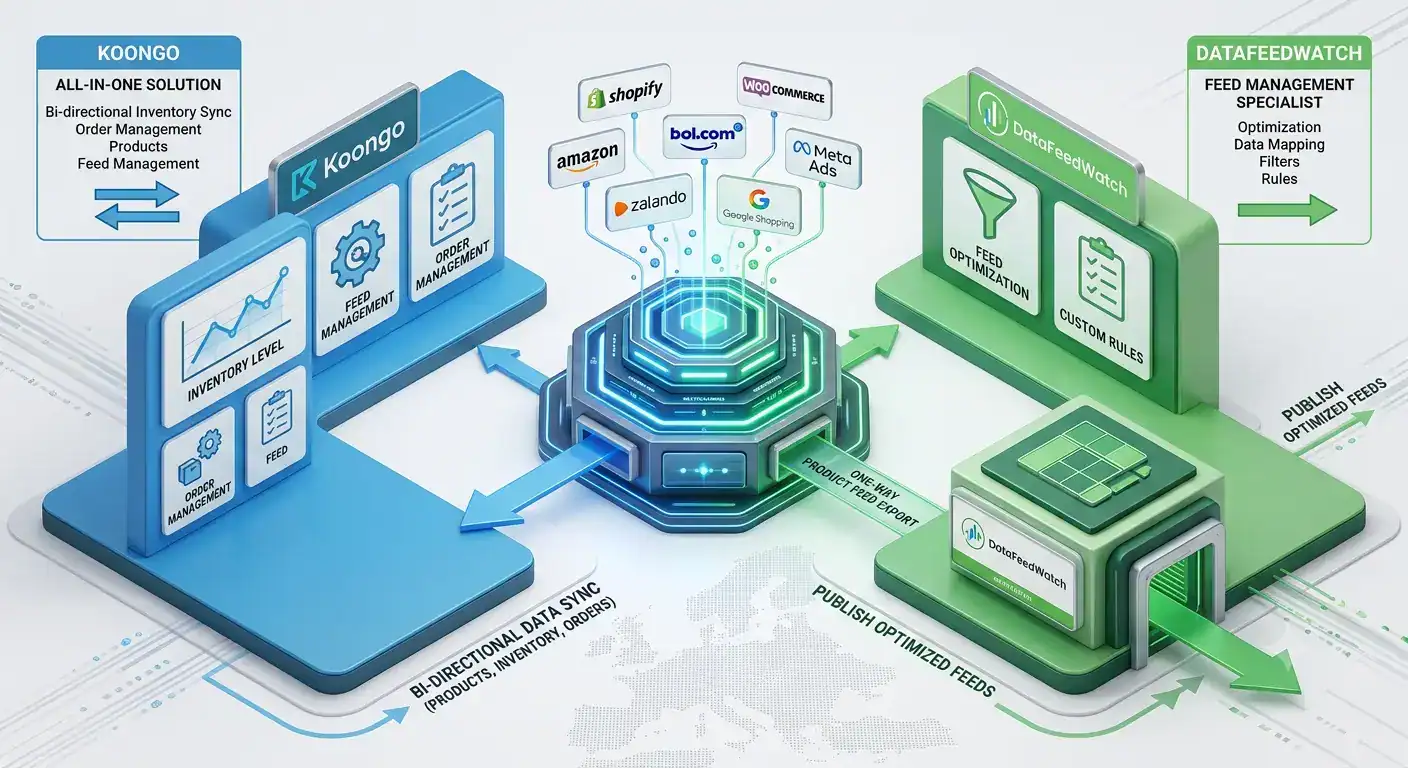
| TL;DR The main difference is feed management vs marketplace management: DataFeedWatch focuses on feed optimisation for advertising channels, while Koongo combines feed management with marketplace API integration, order sync, and inventory sync. Koongo offers a permanent Free Plan and paid plans from EUR 12/month with a 7-day free trial – no credit card required. Feed Manager is included in every plan as standard. Marketplace Manager is an add-on service and combining both costs the same as Marketplace Manager alone. DataFeedWatch’s plans start at EUR 54/month for the Shop tier, with no permanent free plan. Koongo’s marketplace order and inventory synchronization – and its bol.com Silver Partner status – are key differentiators for merchants selling directly on marketplaces, not just running ad feeds. DataFeedWatch’s larger channel library (2,000+ across 60+ countries) suits agencies focused purely on advertising feed optimisation. |
If you are comparing product feed tools, the decision usually comes down to one core distinction: feed management vs marketplace management. Feed management tools optimise and distribute your product data to advertising and comparison channels like Google Shopping or Meta Ads. Marketplace management goes further – it connects your store directly to marketplaces like Amazon, bol.com, or Zalando, syncing not just product listings but also inventory and orders.
This comparison is for merchants evaluating Koongo Pricing against DataFeedWatch as a DataFeedWatch alternative – particularly those selling on multiple marketplaces and channels from Shopify, WooCommerce, or Magento. DataFeedWatch is built primarily for feed management. Koongo combines feed management and marketplace integration software in one platform, which matters most if your roadmap includes direct marketplace selling rather than advertising feeds alone.
Below, we compare pricing, features, marketplace coverage, ease of use, and real costs for a sample store, so you can see which platform fits your specific situation.
Obsah
- What is Koongo?
- What is DataFeedWatch?
- How does pricing compare between Koongo and DataFeedWatch?
- Why merchants switch from DataFeedWatch to Koongo
- How do the features compare?
- Which platform offers stronger marketplace coverage?
- Which platform is easier to set up and use?
- What do customers say about each platform?
- What are the pros and cons of each platform?
- When does it make sense to switch to Koongo?
- Koongo vs DataFeedWatch for Shopify
- Koongo vs DataFeedWatch for WooCommerce
- Example: Shopify store with 800 products
- Frequently Asked Questions
- Conclusion: which should you choose?
Koongo vs DataFeedWatch at a glance
| Feature | Koongo | DataFeedWatch |
| Free Plan | Yes | No |
| Feed Management | Yes | Yes |
| Marketplace Order Sync | Yes | No |
| Inventory Sync | Yes | Limited |
| Shopify Integration | Yes | Yes |
| bol.com Integration | Native | Feed-based |
| Starting Price | EUR 12/month (paid); Free Plan available | EUR 54/month (Shop tier); no free plan |

What is Koongo?
Koongo is an e-commerce data integration platform that helps online merchants sell on 500+ sales channels – including marketplaces, advertising platforms, and comparison shopping engines – from a single system. It combines two core products: Feed Manager, which automates product feed creation and distribution to channels like Google Shopping, Meta Ads, and Idealo, and
Marketplace Manager, an API-based wizard integration for selling on marketplaces such as Amazon, bol, Zalando, Kaufland, and eBay with full product, order, and inventory sync. Every paid Koongo plan includes both products – merchants do not need to purchase feed management and marketplace integration separately.
Koongo was built with European multi-channel sellers in mind, with particularly strong coverage across the Netherlands, Belgium, and Scandinavia – including a Silver Partner relationship with bol.com. It supports Shopify, WooCommerce, Magento, PrestaShop, BigCommerce, and Wix, and updates product and inventory data every 5, 15, or 30 minutes depending on plan.
| Koongo at a glance 500+ ready-to-use feed templates across advertising, comparison, and marketplace channels. Feed Manager included in every plan as standard; add Marketplace Manager for full marketplace selling at no extra cost over Marketplace Manager alone.Update frequency: every 5, 15, or 30 minutes Pricing: permanent Free Plan available; paid plans from EUR 12/month, 7-day free trial, no credit card required Strong Benelux, DACH, and Nordic marketplace coverage, including bol.com, Beslist, Marktplaats, and CDON |
What is DataFeedWatch?
DataFeedWatch, now owned by Cart.com, is a feed marketing platform that helps merchants and agencies transform and optimise product data feeds for advertising and shopping channels. It supports rule-based feed transformation, A/B testing of titles and descriptions, and pre-loaded templates for major channels.
DataFeedWatch’s strength is in feed-side optimisation and channel coverage for advertising. As a feed management software platform, it operates primarily as a feed transformation tool rather than a full marketplace selling and order management system – which is the core distinction to keep in mind throughout this comparison.
| DataFeedWatch at a glance Distributes feeds to 2,000+ channels across 60+ countriesRule-based feed transformation and A/B testing for titles and descriptions Integrates with Shopify, WooCommerce, Adobe Commerce (Magento), PrestaShop, Lightspeed, and others. No native API for marketplace order or inventory sync – feed-focused rather than marketplace-selling-focused. Feed update frequency: up to 24 scheduled updates per day for advertising feeds; no real-time bi-directional marketplace inventory sync Pricing: Shop plan from EUR 54/month, Merchant from EUR 74/month, Agency from EUR 219/month, plus custom Enterprise |
How does pricing compare between Koongo and DataFeedWatch?
Pricing is one of the clearest differentiators between the two platforms. Koongo’s entry-level plan is positioned for smaller merchants who want to start with a manageable monthly cost and every plan, including the Free Plan, gives access to both feed management and marketplace integration software. DataFeedWatch’s plans are priced higher across the board and scale toward agency and enterprise use.
| Koongo | DataFeedWatch | |
| Free plan | Yes – permanent Free Plan, no credit card required | No permanent free plan |
| Entry-level paid plan | From EUR 12/month – Feed Manager included as standard; Marketplace Manager available as add-on (combined pricing same as M. M. alone) | Shop: from EUR 54/month – feed management only |
| Mid-tier plan | Scales by product/channel volume | Merchant: from EUR 74/month |
| Agency / high-volume plan | Custom plans available for high SKU counts | Agency: from EUR 219/month |
| Enterprise | Custom pricing on request | Custom Enterprise pricing |
| Free trial | 7 days, no credit card required | Free trial available (typically 15 days) |
| Annual discount | Available on annual billing | Up to 15% savings on yearly plans |
For a small merchant with under 1,000 SKUs selling on 3-4 channels, the price difference between a permanent Free Plan or EUR 12/month and EUR 54/month is meaningful particularly in the first year while validating channel performance. DataFeedWatch’s pricing structure is more clearly oriented toward agencies and merchants who need to manage multiple shops or larger product catalogs from day one.

Why merchants switch from DataFeedWatch to Koongo
Merchants moving from DataFeedWatch to Koongo typically cite a combination of cost and scope. DataFeedWatch handles feed optimisation well, but merchants expanding into direct marketplace selling often find they need a second tool – or a manual workaround – for order and inventory sync. Koongo’s combined approach addresses both needs from one subscription.
| Common reasons merchants switch Lower entry cost – Koongo’s paid plans start from EUR 12/month versus EUR 54/month for DataFeedWatch’s Shop plan. Permanent Free Plan – merchants can run a real feed and test marketplace integration software before paying anything.Marketplace order sync – orders placed on Amazon, bol.com, or Zalando flow back into the merchant’s store automatically, without manual entry.Inventory synchronization – stock levels update across every connected channel every 5, 15, or 30 minutes, reducing the risk of overselling. Fewer tools to manage – one platform where Feed Manager comes standard and Marketplace Manager can be added at no additional cost over the marketplace plan price, no separate feed tool subscription needed Stronger Benelux and Nordic marketplace support – including bol.com, Beslist, Marktplaats, and CDON, which DataFeedWatch covers only thinly.bol.com Silver Partner status – giving Koongo merchants a more direct, supported integration path for one of the most requested marketplaces among Dutch and Belgian sellers. |
Not every merchant needs to switch. If your operation is purely feed-based running Google Shopping and Meta Ads campaigns without direct marketplace selling – DataFeedWatch’s feature set may already cover your needs. The switch tends to make the most sense once marketplace selling, order sync, or inventory sync become part of the requirement.
How do the features compare?
Both platforms handle the core job of transforming your product data into the format each channel requires. The meaningful differences show up in scope: whether the platform stops at feed delivery, or extends into full marketplace order and inventory management.
| Feature | Koongo | DataFeedWatch |
| Feed management (Google Shopping, Meta Ads, etc.) | Yes – Feed Manager | Yes – core product |
| Marketplace API integration (Amazon, bol.com, Zalando) | Yes – Marketplace Manager with order/inventory sync | Not a native API marketplace integration |
| Order synchronisation | Yes, for connected marketplaces | Not a core feature |
| Inventory synchronisation | Yes, every 5/15/30 minutes | Stock data flows into feeds; not bi-directional marketplace sync |
| Attribute mapping / rules engine | Yes – no-code Rules Editor | Yes – rule-based transformation |
| A/B testing of titles/descriptions | Available on select plans | Yes – established feature |
| Custom feed builder (XML/CSV/TXT) | Yes | Yes |
| No-code setup wizard | Yes – Marketplace Manager Wizard | Feed setup is template-based, not wizard-driven for marketplaces |
“Merchants with fewer orders can start on a slower sync plan and upgrade later — lower cost at the start, scale when the volume justifies it.”
The key structural difference remains feed management vs marketplace management: Koongo treats marketplaces as a first-class integration with order and inventory sync handled through dedicated API connections, while DataFeedWatch’s core architecture is feed-centric. If your priority is purely optimising Google Shopping and Meta Ads feeds, this difference may not matter much to you. If you plan to sell directly on bol.com, Amazon, or Zalando and need orders flowing back into your store automatically, it matters a great deal.
Which platform offers stronger marketplace coverage?
Channel count alone does not tell the full story. What matters is whether your specific markets and marketplaces are well supported. This is where the two platforms diverge most by use case and geography. For merchants evaluating bol.com integration or
Amazon integration specifically, this section is the most relevant comparison point.
| Coverage area | Koongo | DataFeedWatch |
| Total channels | 500+ ready-to-use templates | 2,000+ channels across 60+ countries |
| bol.com | Silver Partner; native API integration | Limited / feed-based only |
| Benelux marketplaces (Beslist, Marktplaats) | Strong native coverage | Minimal dedicated coverage |
| Nordic marketplaces (CDON, Miinto) | Native integration | Limited |
| Amazon, eBay, Zalando, Kaufland | API-based Marketplace Manager | Feed-based; primarily advertising/comparison focus |
| Google Shopping, Meta Ads, TikTok | Yes – Feed Manager | Yes – core strength |
| Geographic strength | Western Europe, especially Benelux and Nordics | Broad global coverage, strong US/UK presence |
For merchants whose primary markets are the Netherlands, Belgium, or Scandinavia, Koongo’s marketplace depth in those regions – including its bol.com Silver Partner status is a practical advantage that a broader, more US/UK-oriented feed tool does not replicate. For agencies managing advertising feeds across dozens of clients and channels globally, DataFeedWatch’s larger channel library may offer more flexibility.

Which platform is easier to set up and use?
Setup complexity differs based on what you are trying to connect. For advertising feeds (Google Shopping, Meta Ads), both platforms offer template-based setup that most merchants can complete without developer help.
Where the experience diverges is marketplace integration. Koongo’s Marketplace Manager Wizard walks merchants through API credential setup, attribute mapping, and inventory rule configuration step by step – designed specifically for non-technical users connecting to a marketplace for the first time. DataFeedWatch’s setup process is built around feed templates and rule configuration; user reviews consistently describe the learning curve as manageable but requiring a few hours to get comfortable with rule logic and field mapping, particularly for non-technical users.
| Setup factor | Koongo | DataFeedWatch |
| Marketplace setup (e.g. bol.com, Amazon) | Guided wizard, no coding | Not a core focus; feed-based workaround only |
| Advertising feed setup (e.g. Google Shopping) | Template-based, straightforward | Template-based, well established |
| Learning curve for rule logic | Moderate; no-code Rules Editor | Moderate to steep for advanced rules per user reviews |
| Time to first live feed | Typically under a day for standard channels | Typically under a day for standard channels |
What do customers say about each platform?
Support quality is one of the most consistently mentioned factors in reviews of both platforms, though the emphasis differs slightly by user base.
| What reviewers commonly highlight Koongo: hands-on, responsive support during setup and complex configuration is the most consistently praised aspect – particularly valued by smaller merchants without a dedicated technical team. DataFeedWatch: users frequently note fast, knowledgeable support for feed rules and mapping, along with an intuitive interface once the initial learning curve is past. Some reviewers note the dashboard can feel dated and that advanced filtering options are harder to learn without guidance. |
What are the pros and cons of each platform?
Koongo: pros and cons
| Pros | Cons |
| Combines feed management + marketplace API integration in every plan | Smaller total channel library (500+) than DataFeedWatch |
| Strong Benelux/Nordic marketplace depth (bol.com Silver Partner) | Less established brand recognition among large agencies |
| Lower entry pricing, from EUR 12/month, plus a permanent Free Plan | A/B testing features are less mature than DataFeedWatch’s |
| Order and inventory sync built into marketplace connections | Smaller community/template library for niche advertising channels |
| 7-day free trial, no credit card required | Less global reach outside Western Europe than DataFeedWatch |
DataFeedWatch: pros and cons
| Pros | Cons |
| Large channel library: 2,000+ channels across 60+ countries | Higher entry pricing, from EUR 54/month |
| Mature A/B testing for titles and descriptions | No native API for direct marketplace order/inventory sync |
| Strong reputation among agencies managing multiple advertising accounts | Less dedicated coverage of Benelux and Nordic marketplaces |
| Established integrations across major e-commerce platforms | No native API; some integrations rely on file-based exchange |
| Responsive support for feed rules and field mapping | No permanent free plan; only a time-limited trial |
When does it make sense to switch to Koongo?
Koongo is the stronger fit when your roadmap includes direct marketplace selling not just advertising feed optimisation. The combined feed and marketplace approach removes the need to run two separate tools for feed distribution and marketplace order management.
| Koongo is likely the better fit if you: Sell or plan to sell on bol.com, Amazon, Zalando, Kaufland, or other marketplaces requiring order and inventory sync are a small to mid-size merchant (under 5,000 SKUs) looking for an affordable entry point. Primarily target Benelux, DACH, or Nordic marketsWant to manage feed distribution and marketplace selling from one dashboard instead of two separate toolsValue hands-on support during setup over a larger self-serve template library |
| DataFeedWatch may be the better fit if you: Run an agency managing advertising feeds across many client accounts and channelsNeed the largest possible channel library for niche or regional advertising platforms. Primarily focus on Google Shopping, Meta, and comparison shopping engines rather than direct marketplace sellingOperate mainly in US/UK markets with less reliance on Benelux or Nordic marketplaces |
Koongo vs DataFeedWatch for Shopify
Shopify merchants comparing these two platforms usually fall into one of two groups. The first group runs advertising and comparison feeds only – Google Shopping, Meta Ads, maybe a price comparison site – and has no current plans to sell directly on a marketplace. For this group, both Koongo and DataFeedWatch handle Shopify marketplace integration for advertising feeds reasonably well, and the choice often comes down to pricing and channel library size.
The second group is Shopify merchants selling – or planning to sell – on multiple channels including marketplaces: Amazon, bol.com, Zalando, Kaufland, or similar. For this group, the distinction between feed management and marketplace management becomes the deciding factor.
| What multichannel Shopify merchants need beyond feeds: Marketplace order synchronization – orders from Amazon, bol.com, or Zalando appearing automatically in the Shopify admin, without manual re-entryInventory synchronization – stock levels staying accurate across Shopify and every connected marketplace, reducing the risk of overselling. Product feed automation – the same product catalog flowing correctly to both advertising channels and marketplaces, formatted to each channel’s requirementsMarketplace-specific listing rules – meeting Amazon’s attribute requirements, bol.com’s category mapping, or Zalando’s content standards, without manual reformatting per channel |
For a Shopify store selling only through advertising channels, DataFeedWatch’s feed-management focus and larger channel library are a reasonable fit. For a Shopify store selling on Amazon, bol.com, Zalando, or Kaufland alongside advertising channels, Koongo’s combined Feed Manager and Marketplace Manager – with order sync and inventory sync included in every plan – addresses a requirement that DataFeedWatch was not built to cover natively.
Koongo vs DataFeedWatch for WooCommerce
WooCommerce merchants face the same fundamental choice as Shopify users: whether they need feed management only, or feed management combined with full marketplace selling. Both Koongo and DataFeedWatch integrate natively with WooCommerce for advertising feed distribution Google Shopping, Meta Ads, and comparison channels. The meaningful difference, again, appears the moment you want to sell directly on Amazon, bol.com, Zalando, or Kaufland and have those marketplace orders flow back into WooCommerce automatically.
Koongo’s WooCommerce integration handles the full multi-channel loop: product listings push from WooCommerce to every connected channel, marketplace orders import back into the WooCommerce order dashboard automatically, and inventory levels sync in real time across all channels preventing overselling even on busy days. The Marketplace Manager Wizard walks WooCommerce merchants through marketplace setup step by step, with no coding required. DataFeedWatch connects to WooCommerce for feed generation but does not offer native bi-directional order and inventory sync with marketplaces merchants who need that typically add a separate connector tool.
For a WooCommerce store running only Google Shopping and Meta Ads, either platform works. For a WooCommerce store selling on marketplaces alongside advertising channels, Koongo’s all-in-one approach removes the need for a second marketplace connector tool.
Example: Shopify store with 800 products
To make the cost comparison concrete, here is how the two platforms might compare for a Shopify merchant with 800 products selling on Google Shopping, Meta Ads, and one marketplace (bol.com).
| Koongo | DataFeedWatch | |
| Plan needed | Entry-level paid plan (or Free Plan for testing) | Shop plan (feed management only) |
| Monthly cost (approx.) | From EUR 12/month | From EUR 54/month |
| Annual cost (approx.) | From EUR 288/year (before any annual discount) | From EUR 648/year (before any annual discount) |
| Feed management included | Yes | Yes |
| bol.com order sync included | Yes – native API integration | Not included – would require a separate tool or manual process |
| Inventory sync across channels | Yes, included | Not included for marketplace order flow |
| Number of tools required | One | One for feeds; a second tool or manual workflow likely needed for bol.com order management |
The direct monthly cost difference is real but modest at this scale. The more significant factor for this type of merchant is scope: if bol.com order and inventory sync are handled manually or through a second tool when using DataFeedWatch, that adds operational time and complexity that does not show up in the subscription price. Reducing the number of tools in a workflow does not eliminate work, but it does reduce the number of places where data can fall out of sync and the number of dashboards a merchant needs to check daily.
These figures are indicative and will vary based on your exact product count, channel mix, and chosen plan tier. Use them as a starting point for your own cost comparison rather than a precise quote.
Frequently Asked Questions
Is Koongo a good alternative to DataFeedWatch?
Koongo is a reasonable DataFeedWatch alternative for merchants who need more than feed management – specifically, those who sell or plan to sell directly on marketplaces and need order and inventory synchronization included. If your needs are limited to advertising feed optimisation with the widest possible channel library, DataFeedWatch remains a strong option in its own right.
Does Koongo work with Shopify?
Yes. Koongo integrates with Shopify for both feed management (Google Shopping, Meta Ads, comparison channels) and marketplace management (Amazon, bol.com, Zalando, Kaufland, and others), with product, inventory, and order data syncing automatically between Shopify and each connected channel.
Which platform is better for bol.com sellers?
Koongo, for merchants who need a native marketplace connection. Koongo holds bol.com Silver Partner status and connects via API integration with full order and inventory sync. DataFeedWatch’s bol.com support is feed-based, which covers product listing data but does not include the same level of native order synchronization.
Does Koongo include marketplace order synchronization?
Yes. Marketplace order synchronization is included in Koongo’s Marketplace Manager, which comes with every paid plan. Orders placed on connected marketplaces such as Amazon, bol.com, or Zalando flow into your store’s order management system automatically.
Can I start using Koongo for free?
Yes. Koongo offers a permanent Free Plan with no credit card required, in addition to a 7-day free trial on paid plans. This allows merchants to test feed management and marketplace integrations before committing to a paid subscription.
Can I migrate from DataFeedWatch to Koongo?
Yes. Migration typically involves exporting your existing channel list and feed mappings from DataFeedWatch, then rebuilding them in Koongo’s Feed Manager using its 500+ pre-built channel templates and no-code Rules Editor. For marketplace connections (Amazon, bol.com, Zalando), Koongo’s Marketplace Manager Wizard guides you through the setup step by step no developer needed. Koongo’s support team actively assists during onboarding, and most merchants complete their core channel setup within the first week.
Which platform supports more marketplaces in the Netherlands and Belgium?
Koongo has deeper native coverage of Benelux marketplaces, including a Silver Partner relationship with bol.com, along with support for Beslist and Marktplaats. DataFeedWatch’s strength lies more in broad advertising and comparison channel coverage rather than dedicated Benelux marketplace depth.
Does Koongo work with WooCommerce?
Yes. Koongo integrates with WooCommerce for both feed management (Google Shopping, Meta Ads, comparison channels) and marketplace management (Amazon, bol.com, Zalando, Kaufland, and others). Product listings, inventory levels, and marketplace orders all sync automatically between WooCommerce and every connected channel without manual data entry or a separate connector tool. The Marketplace Manager Wizard guides WooCommerce merchants through the full setup with no coding required.
Conclusion: which should you choose?
| Choose Koongo if: You need feed management and marketplace integrations in one platform. You sell on bol.com, Amazon, Zalando, or Kaufland. You need order synchronization between marketplaces and your store. You want a permanent free plan to test before paying. You want lower entry costs as a small or mid-size merchant |
| Choose DataFeedWatch if:Your focus is exclusively feed optimization for advertising channels. You manage many advertising feeds across multiple client accounts. Marketplace order synchronization is not a current requirement |
For European SMB merchants selling across multiple channels – particularly those with marketplaces like bol.com, Amazon, Zalando, or Kaufland in their growth plans – Koongo’s combined feed management and marketplace management software, lower entry pricing, and permanent free plan make it the more complete starting point. Merchants whose needs are limited to advertising feed optimisation, with no marketplace order or inventory sync requirement, may find DataFeedWatch’s larger channel library a better match for that narrower use case. The right choice depends less on which platform is the better overall product and more on whether marketplace selling is part of your strategy.
| See how Koongo compares for your specific channels Koongo combines feed management and marketplace selling in one platform, with a permanent free plan and paid plans from EUR 12/month – 7-day free trial, no credit card required. Connect your store and see your first feed live within a day. |