Menu

Blog

How AI Assistants Can Help Manage Marketplace Integrations

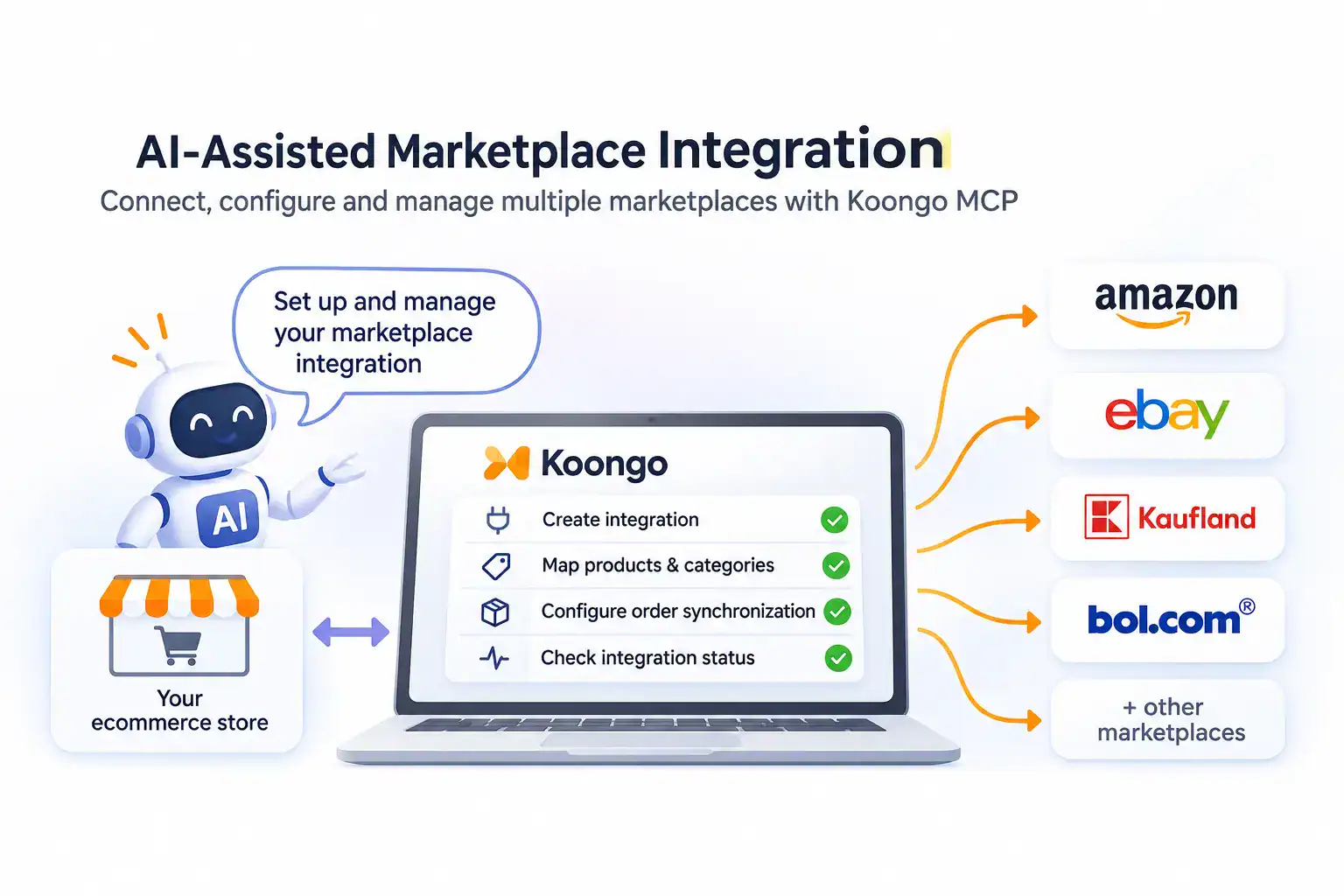
Selling on multiple marketplaces means managing different product requirements, category structures, account connections, listing settings, and order workflows.

AI assistants can make this process easier by connecting directly to ecommerce tools through the Model Context Protocol (MCP).

With Koongo MCP, compatible AI assistants can work with supported Koongo marketplace integration tools using natural-language instructions.

You can ask an AI assistant to create a marketplace integration, guide you through its setup, help with product and category mappings, configure supported order synchronization, and check the integration status.

This guide explains how AI-assisted marketplace integration works and how Koongo MCP can help merchants connect and manage marketplaces such as Amazon, eBay, Kaufland, bol.com, and other supported sales channels.
Continue reading -> Continue reading →

Koongo MCP Is Live: Manage Your Ecommerce Operations with AI Assistants

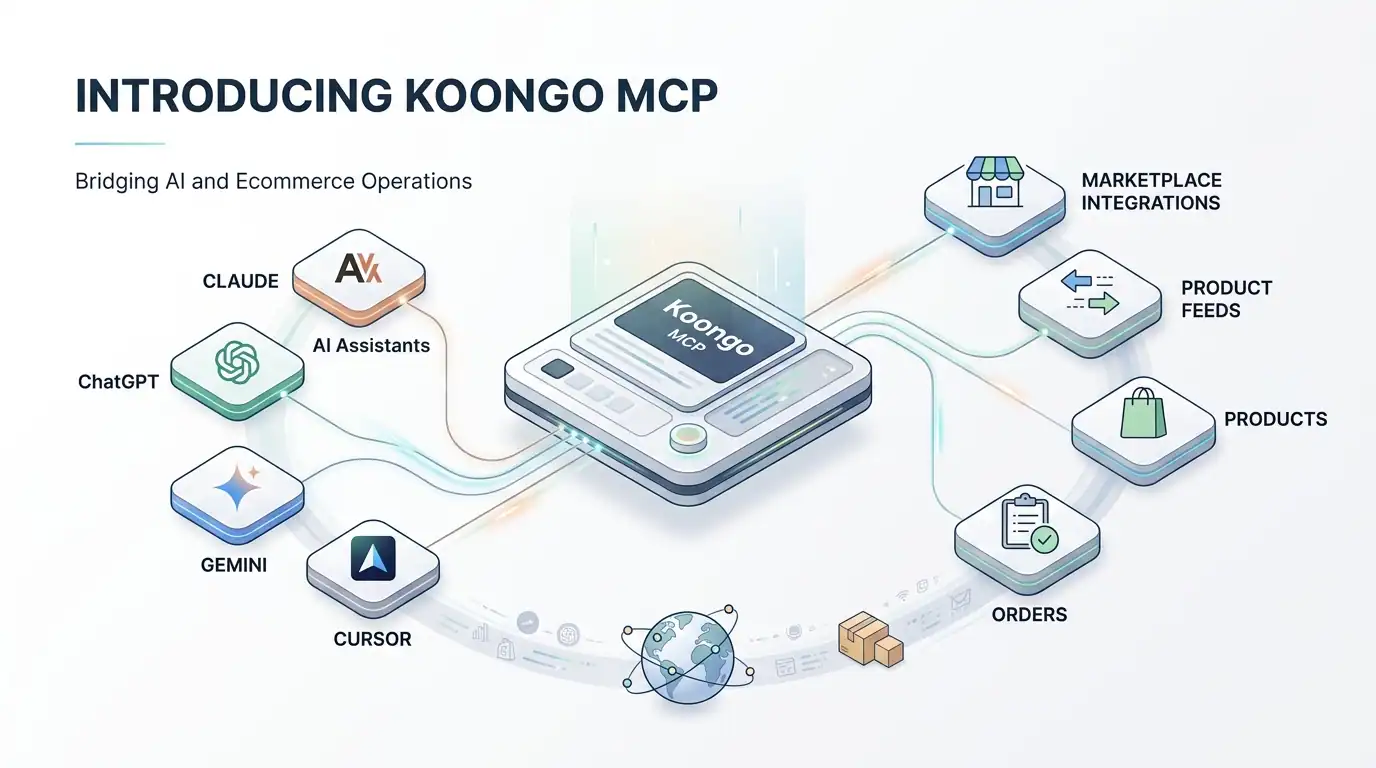
Managing a multichannel ecommerce business usually means switching between dashboards, configuring integrations, mapping product attributes, creating feeds, checking product data, and managing marketplace orders.

Koongo MCP introduces a different way to handle these tasks through a conversation with your AI assistant.

Koongo MCP is now live and connects MCP-compatible AI assistants such as Claude, ChatGPT, Gemini, and Cursor to your Koongo account. Instead of navigating every setting manually, you can describe what you want to accomplish and let the AI assistant work with supported Koongo tools and data on your behalf.

You can use it to create marketplace integrations, configure product feeds, map attributes and categories, enrich missing product information, inspect your setup, and work with marketplace orders.

Koongo MCP is available to Koongo customers on the new pricing model, including the Free plan, with no separate MCP fee currently planned.

Continue reading -> Continue reading →

ChatGPT Shopping product feeds: setup with Koongo

Your customers have started asking ChatGPT what to buy. “A carry-on backpack that fits under the seat,” “a quiet fan for a small bedroom,” and the assistant may answer with real products: images, prices, and a link to a store. Accurate product data helps ChatGPT understand what you sell, and a product feed is the structured way to supply it. Submitting a feed doesn’t guarantee that your products appear in any given answer, but without one, ChatGPT has nothing reliable to work with.

Continue reading -> Continue reading →

How to sell on NordicSneakers: a seller’s guide

Expanding to a new marketplace shouldn’t cost you hours of listing work. NordicSneakers, a fast-growing Danish sneaker marketplace, lets you list with just a SKU and a size, then builds and markets the product pages for you. Here’s how selling on NordicSneakers works, who it suits, and how to run it alongside your other sales channels without overselling.

Continue reading -> Continue reading →

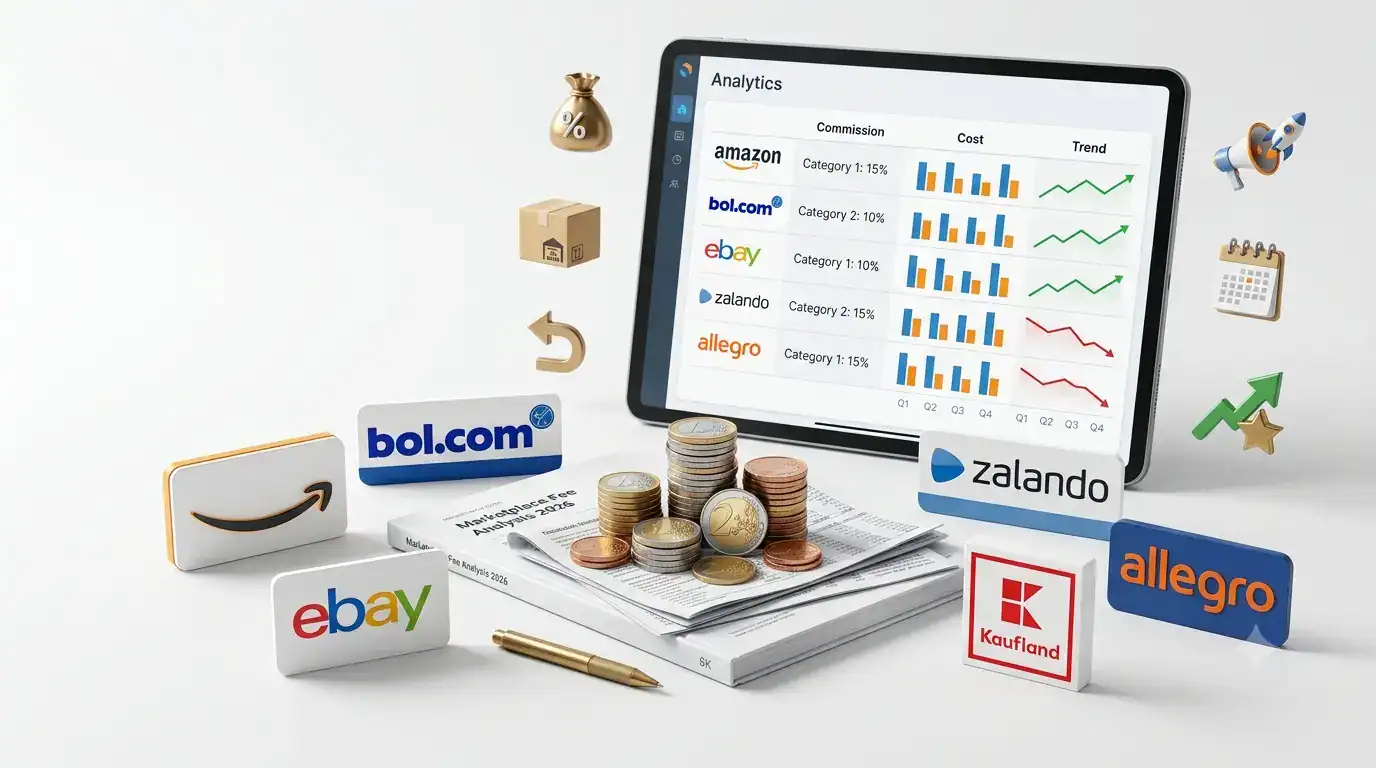
Marketplace Fees Comparison (2026): Amazon, bol.com, eBay, Zalando, Allegro and Kaufland

This comparison is based on publicly available fee schedules, official marketplace documentation, and verified third-party sources as of mid-2026. Fees change regularly. Always verify against your platform’s seller portal before making pricing decisions.

TL;DR

Commission fees across major European marketplaces range from 5% to 25% of the selling price, depending on category and platform.
Amazon reduced its EU referral fees in early 2026 by an average of EUR 0.17 per unit, one of its largest-ever European fee cuts. Clothing now starts at 5% for items under EUR 15.

bol.com charges no monthly seller fee: you pay commission only when you sell. Rates run from 5% to 17% plus a fixed amount per transaction.

Zalando’s total selling cost is the highest of any platform reviewed here: commission of 8-25% plus a monthly fee of EUR 40, and additional marketing spend that partners call effectively mandatory for visibility.

The headline commission rate is never the full cost. FBA fulfillment, return processing, advertising, and monthly fees routinely add 10-20 percentage points to your effective cost per sale.

Marketplace fees are one of the most researched topics in e-commerce, and one of the most misunderstood. Most guides compare headline commission rates as if they were the only cost. In practice, the commission is one line in a fee stack that can include monthly seller fees, fulfillment costs, return processing fees, advertising spend, and payment processing charges.

This comparison covers the six most relevant marketplaces for European merchants: Amazon, bol.com, eBay, Zalando, Allegro, and Kaufland, with current 2026 rates, the hidden costs that rarely appear in overview tables, and a realistic total-cost model for a sample product to show what you actually pay per sale.

Continue reading -> Continue reading →

Ecommerce Glossary: Complete A-Z Dictionary of Ecommerce Terms (2026)

What Is an Ecommerce Glossary?

An ecommerce glossary is a reference library of terms used across online retail – covering advertising metrics, technical integrations, operational systems, marketplace concepts, and feed management terminology. This glossary is designed for online merchants, ecommerce managers, and digital marketing teams who work with platforms like Shopify, WooCommerce, Amazon, bol.com, and Google Shopping.

Every term in this glossary includes: a clear definition, an AI-optimised summary for quick reference, a concrete ecommerce example, common mistakes to avoid, best practices, and links to related articles and guides.

TL;DR

This glossary covers 35+ essential ecommerce terms with definitions, examples, common mistakes, and best practices – built for online merchants who want to understand the language of multichannel selling.

Key terms span product feeds, marketplace integration, advertising metrics (ROAS, CPC, CTR), and operational systems (ERP, PIM, OMS).

Each entry includes an AI-ready summary, a concrete ecommerce example, and links to relevant guides.

Use the A-Z index below to navigate directly to any term, or scroll through the full glossary alphabetically.
Continue reading -> Continue reading →

Marketplace Glossary (A-Z): 120+ Marketplace Terms Every Seller Should Know

All definitions are based on official marketplace documentation from Amazon Seller Central, bol.com Partner Platform, Zalando Partner Portal, Allegro Seller Centre, Kaufland Seller Portal, and verified industry sources. Updated mid-2026.

TL;DR

This glossary covers 50+ marketplace terms with definitions, examples, common mistakes, and best practices – built for merchants selling on Amazon, bol.com, Zalando, eBay, Kaufland, and Allegro.

Includes platform-specific terminology for each major European marketplace, plus a full A-Z of universal marketplace and integration terms.

Use the “Frequently Confused Marketplace Terms” section to quickly clarify common misunderstandings (FBA vs FBM, ASIN vs SKU, etc.).
Continue reading -> Continue reading →

How to sell on OnBuy: a seller’s guide

To sell on OnBuy, you register as a seller, list your products in the format OnBuy requires, and keep your stock and orders in sync. The quickest way to do all three is to connect your existing store to OnBuy with Koongo, which automates the data work so you can list in an afternoon rather than a month.

But before the how, the why. OnBuy has a few things going for it that set it apart from the marketplaces most sellers start with. Here’s what OnBuy is, why sellers are moving to it, the one real challenge in getting listed, and exactly how Koongo handles that challenge.

Continue reading -> Continue reading →

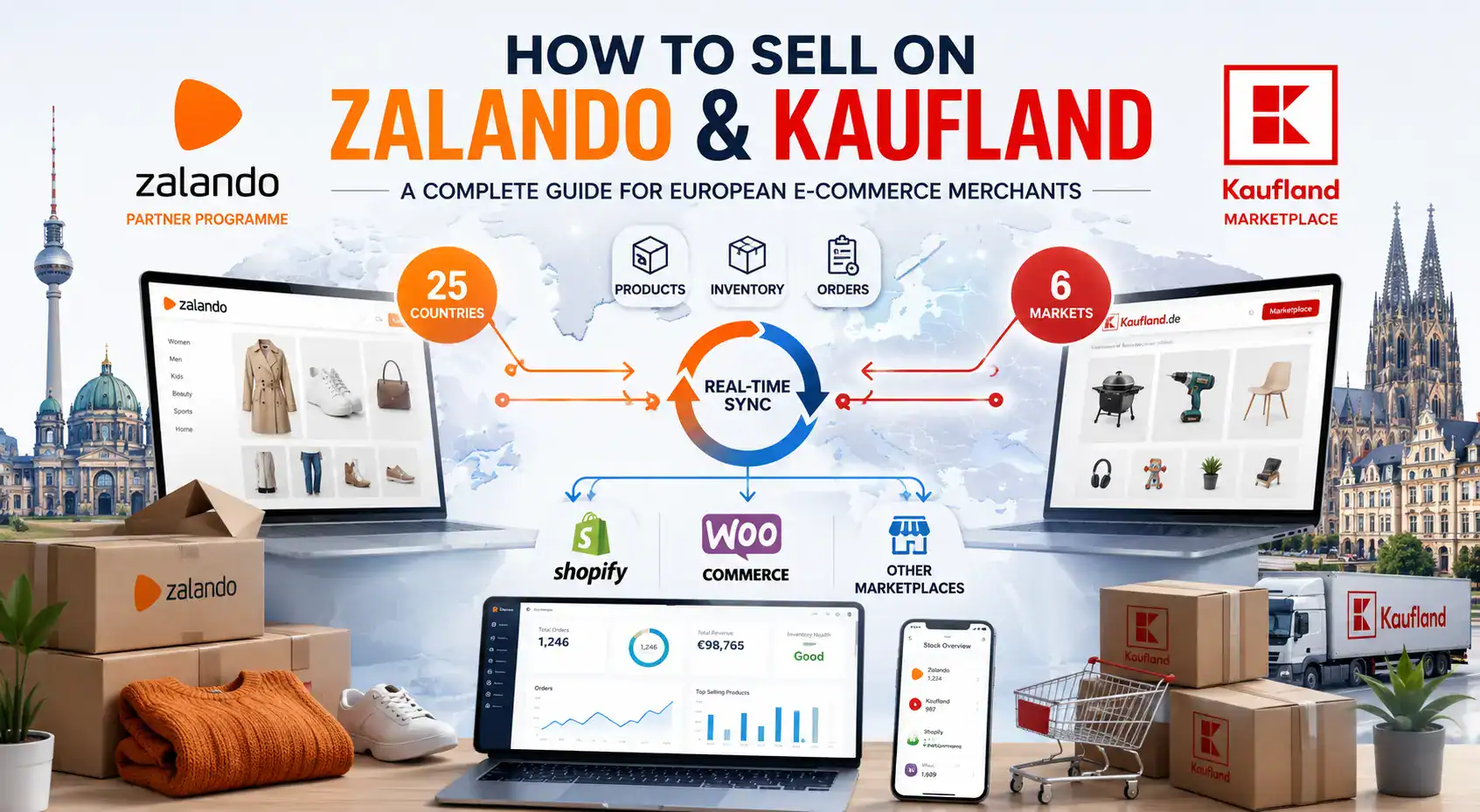
How to Sell on Zalando and Kaufland: A Complete Guide for European E-commerce Merchants

TL;DR
Zalando has 50+ million active customers across 25 European markets – but access requires an application, brand approval, and strict content standards.

Kaufland Marketplace covers Germany, Austria, Czech Republic, Slovakia, Poland, and Romania, with 35+ million monthly visitors and relatively low competition in many categories.Both platforms use API-based connections, not product feeds – setup is done through an integration wizard, not a CSV upload.Zalando’s data quality requirements are among the strictest of any European marketplace: images, product descriptions, and size guides must meet publisher-level standards.

Running Zalando and Kaufland alongside your own store requires automated inventory and order sync – manual management becomes unsustainable above 50 orders per day.

Two of Europe’s fastest-growing marketplaces sit at opposite ends of the onboarding spectrum. Zalando is a premium fashion and lifestyle platform with 50+ million active customers across 25 countries – but getting access requires a formal application, brand review, and a commitment to content standards that most marketplaces do not demand. Kaufland Marketplace, by contrast, is an open-application general marketplace covering six Central European markets with over 35 million monthly visitors and a product mix ranging from electronics to garden furniture.

For European merchants, both represent significant revenue opportunities that most competitors have not yet fully exploited. This guide walks through what each platform requires, where the differences lie, and how to build a workflow that lets you manage both channels alongside your existing store without doubling your operational workload.

Continue reading -> Continue reading →

How to Sell on Amazon from Europe: A Practical Guide for E-commerce Merchants

Amazon is the world’s largest online marketplace, with over 300 million active customer accounts globally and annual third-party seller revenue exceeding $140 billion. For European merchants, selling on Amazon is not just a growth option – it is increasingly a baseline expectation in competitive product categories.

The good news: the barriers to entry are lower than most sellers expect. You do not need a US legal entity, a US bank account, or a dedicated development team to get started. What you do need is a clear understanding of how Amazon’s seller infrastructure works, what product data requirements you must meet, and how to keep your inventory and orders in sync across channels once you are live.

This guide covers everything a European merchant needs to know before listing their first product on Amazon – from account setup and VAT obligations through to product attributes, common errors, and multi-channel order management.

Key Takeaways

European merchants sell via Seller Central using a pan-European or individual marketplace account – no US entity required.

Amazon Vendor Central is an invite-only wholesale programme; most independent merchants use Seller Central.

Each Amazon marketplace has specific product attribute requirements – what works on amazon.de may need adjustment for amazon.fr or amazon.nl.

VAT compliance is the most overlooked cost for new Amazon sellers expanding across EU countries.

Automating inventory and order sync between your existing store and Amazon prevents overselling and reduces manual workload significantly.
Continue reading -> Continue reading →

Sell everywhere with Koongo

or contact us for more details