The fashion industry is a dynamic and ever-evolving market that offers numerous opportunities for entrepreneurs and fashion enthusiasts to start their businesses. One popular avenue is to sell on fashion marketplaces. These platforms provide access to a global customer base, making it easier than ever to reach potential buyers and offer your designer clothes.
Many of Koongo’s clients reach different online fashion marketplaces where they can sell their fashion goods like clothing items or accessories. Fashion is one of the most researched industries on the web, and consumers are always ready to buy.
Koongo simplifies and automates listing and managing products on the fashion online marketplace. Within Koongo, you can effortlessly enhance your product information or choose particular products for your campaigns. Through seamless API integration, your data remains consistently current on those platforms. Koongo helps you reach a broader audience and increase your online sales presence.
Jump ahead to

Selling fashion on an online marketplace can be a rewarding venture when approached strategically. By following these steps and staying committed to providing quality products and exceptional customer service, you can build a successful fashion business in the competitive online marketplace landscape.

Koongo allows you to synchronize your product data and marketplace orders for dedicated online fashion marketplaces. As a leading online marketplace solution, it offers several benefits to online retailers and e-commerce businesses looking to expand their reach, simplify selling process and improve their selling processes on top fashion marketplaces.
Here are some of the key benefits of using Koongo:
Overall, Koongo simplifies the complexities of multi-channel e-commerce and allows businesses to expand their online presence efficiently while maintaining accurate and up-to-date product information across various marketplaces and channels. This can lead to increased sales, improved customer satisfaction, and greater operational efficiency.

Koongo helps online retailers expand their reach by listing and selling products on top online fashion marketplaces and comparison shopping engines. Many of those marketplaces are focused on fashion. Here, you can check the leading fashion marketplaces supported by Koongo.
Zalando was founded in 2008 in Berlin as a leading online marketplace for shoes. By 2010, it had become a market leader in online shoe sales and had incorporated various fashion items into its platform. Zalando is the leading European online retailer of shoes, fashion, and beauty products, with over 50 million active users in 25 European markets. Koongo supports Zalando Partner Program and Zalando Connected Retail to sell clothes and accessories. Sell your high quality items on Zalando.
Zalando’s main features:
Miinto is an online fashion platform created for all fashion consumers and fashion brands who demand the same high level of service and personal experience online that they would expect to shop at their local physical stores. The Miinto concept is based on a collaboration with shop owners and brands, allowing them to go online and drastically expand their market while benefiting from Miinto’s marketing, digital, and technical expertise. Sell clothes online with Miinto!
Miinto’s main features:
Spartoo global fashion group is one of the leading online fashion retailers in Europe, with more than 3 million customers across Europe. More than 2000 brands and 100,000 styles of shoes, clothes, and bags are available. Spartoo is active in 15 countries: France, UK, Spain, Italy, the Netherlands, Sweden, Denmark, Finland, Belgium, Greece, Poland, Portugal, the Czech Republic, Austria, and Germany.
Spartoo’s main features:
The Vintage Bar is a community-driven fashion marketplace based on buying, selling, and providing inspiration, all within premium and luxury vintage items, including exclusive collections. The platform is based on a clear mission: To show that vintage clothing can be as cool and exciting as new items by connecting buyers and sellers worldwide. Visual inspiration and inclusion are two of The Vintage Bar’s core values. By creating an inclusive and relatable social hangout, The Vintage Bar invites their growing community of sellers and buyers to partake in more circularly and sustainable fashion.
TVB’s main features:
Established in 2000, YOOX is the world’s leading online fashion, design, and art store, renowned for its exclusive collections that last a lifetime and beyond. YOOX offers a never-ending selection of products, including an edited range of hard-to-find clothing and accessories from the world’s most prestigious designers, exclusive capsule collections, eco-friendly fashion; a unique assortment of home design objects, rare vintage finds, and books; and a curated selection of compelling and collectible artworks chosen by international curators and critics from the world’s leading galleries and institutions. YOOX is one of the great places to sell clothes online.
Yoox’s main features:
Glami is a search engine for all things fashion that inspires everyone, created to make fashion discovery and shopping a pleasurable experience for fashion brands and consumers alike. This fashion marketplace brings offers from different e-shops and has over 2 million products in the database. It inspires shoppers in the Czech Republic, Slovakia, Romania, Hungary, France, Germany, Russia, Greece, Turkey, and Bulgaria, and it’s expanding fast to even more countries.
Glami’s main features:
Modivo is a leading online marketplace and a European leader in online sales of clothes, footwear and accessories. It combines the offers of e-commerce platforms eobuwie.pl and MODIVO. Thanks to investments in modern technology and the innovative esize.me project, the Company achieves a real integration of online and offline sales channels.
Modivo’s main features:
In the beginning, Amazon sold books. Today, Amazon is a leading online marketplace and a titan of e-commerce, logistics, payments, luxury items, hardware, home decor, designer items, data storage, fashion items, and media. It dabbles in plenty of more industries. It’s the go-to site for online shoppers and merchants alike, a modern necessity that independent sellers love to have.
Amazon’s main features:
eBay is a leading online marketplace founded in 1995. It enables people and businesses to buy and sell a wide range of products, either through auctions or fixed-price listings. has a global presence, seller ratings, and offers tools like eBay Stores for customization. It also has sections like eBay Motors for automotive-related items. The platform has evolved and is known for its mobile apps, PayPal integration (though this has changed over time), and eBay Partner Network. eBay promotes corporate responsibility and sustainability.
eBay’s main features:
Facebook Marketplace is a leading online marketplace integrated with the social network, where users can buy, sell, and trade various items with people in their local communities. It allows individuals and businesses to list products, communicate with potential buyers or sellers, and arrange in-person transactions. Facebook Marketplace is a convenient way to discover local deals, including items like furniture, electronics, clothing, and more. Users can access it through the Facebook app or website, making it easy to connect with nearby buyers and sellers.
Facebook Marketplace’s main features:
Sellers can use Instagram, a leading online marketplace, to sell products directly to customers. It involves visual posts, product tagging, shoppable posts, and features like Instagram Shops and live shopping. Sellers can collaborate with influencers and use advertising.
Instagram’s main features:
Sellers can use Pinterest, a leading online marketplace, to showcase and sell products through Product Pins, Shop tabs, Buyable Pins, and advertising. It leverages Pinterest’s visual focus for effective product promotion.
Pinterest’s main features:
For more information about all Koongo-supported fashion online marketplaces, please check Koongo fashion marketplaces list.
Start your 30-day free trial of Koongo and upload your product data. Then, follow an online marketplace guide and set up the channel integration. If you have any questions, please email support@koongo.com.
We are here to support you every step of the way, ensuring that your experience with Koongo is always great.perience with Koongo is always great.
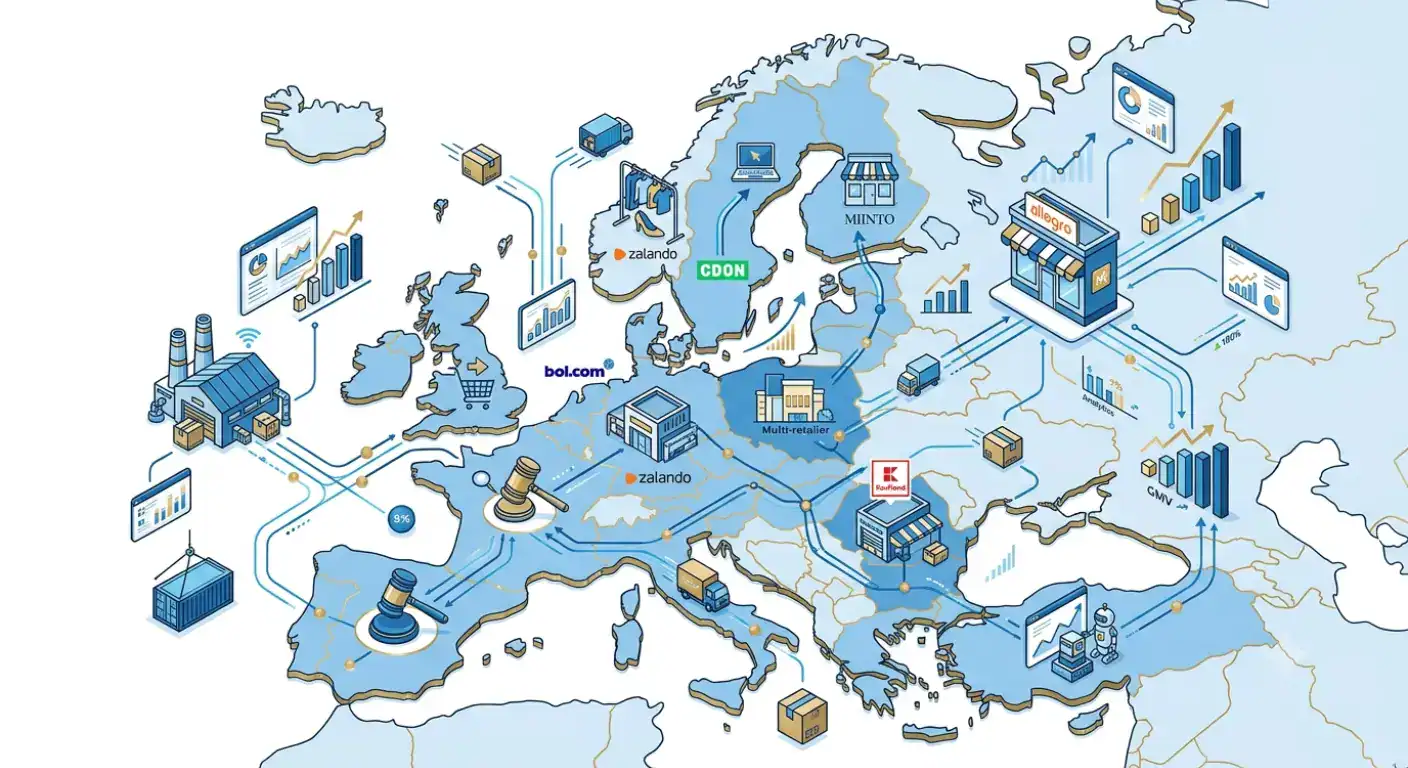
Continue reading →All statistics are sourced from official company earnings reports, annual reports, and verified third-party research including Marketplace Pulse, ECDB, Lengow, and primary company disclosures. Data reflects the most recent available figures as of mid-2026.
| TL;DR Amazon surpassed USD 800 billion in total GMV in 2025, with third-party sellers now representing 62% of all units sold and 69% of total GMV. eBay reported USD 79.6 billion in GMV and 135 million active buyers for full-year 2025, with Q1 2026 GMV growing 18% year-on-year. Zalando reached a record 62 million active customers and EUR 17.6 billion in GMV in 2025, growing 14.7% year-on-year. Allegro advanced to 21 million group active buyers with Polish GMV growing at 8.6% year-on-year – more than double Poland’s overall retail growth. Kaufland Global Marketplace attracted up to 43 million monthly visitors across all countries, with overall network GMV growing 11.9% in 2025 and international GMV up 124%. |
Marketplaces now account for more than 60-67% of all global ecommerce sales – and for European merchants, understanding the specific platforms that serve their customers is more useful than global aggregates. This article compiles key statistics for each major European marketplace from their most recent official reports and verified research sources, so you can benchmark each platform’s scale, growth, and seller dynamics in one place.
Every figure here is attributed to its primary source, with direct links where available. Where exact numbers are not publicly disclosed (as with bol.com, which is a subsidiary of Ahold Delhaize and does not publish separate annual reports), we use the most reliable third-party estimates and note the methodology.
Continue reading -> Continue reading →Expanding to a new marketplace shouldn’t cost you hours of listing work. NordicSneakers, a fast-growing Danish sneaker marketplace, lets you list with just a SKU and a size, then builds and markets the product pages for you. Here’s how selling on NordicSneakers works, who it suits, and how to run it alongside your other sales channels without overselling.
Continue reading -> Continue reading →Clear, quick definitions of 90+ product feed, marketplace, and multichannel-selling terms you’ll come across when connecting your store to Google Shopping, Amazon, bol.com, Zalando, and 500+ other channels.
Want the full picture on a topic, not just a quick definition? Our two in-depth guides cover every term here in much greater detail, with examples, common mistakes, and best practices: the Ecommerce Glossary (A-Z) and the Marketplace Glossary (120+ terms). Each entry below also links onward to the most relevant guide for that specific term.
A UPC is the 12-digit barcode standard used mainly in North America — a GTIN-12. It plays the same role as Europe’s EAN-13: a unique, externally registered identifier required by advertising and marketplace channels to list and match products.
Related terms: GTIN, EAN, ASIN
Learn more: Product Feed guide →
A product catalog is the complete set of products and product data a merchant maintains — the source from which channel-specific feeds, marketplace listings, and PIM exports are generated. Its accuracy sets the ceiling for every channel built from it.
Related terms: PIM, Product Feed, Attribute Mapping
Learn more: Product Feed guide →
Catalogue matching links your product to an existing listing already in a marketplace’s catalog, using an identifier like GTIN or EAN, instead of creating a duplicate page. A successful match gives instant access to that page’s existing reviews and traffic.
Related terms: GTIN, ASIN, Listing
Learn more: Sell on Marketplaces →
A product feed is a structured file — usually XML, CSV, or JSON — that contains your product catalog data (titles, prices, images, availability, identifiers) formatted to the requirements of a specific sales channel. Feeds are how merchants distribute their catalog to Google Shopping, marketplaces, and comparison sites.
Related terms: Feed Management, XML Feed, CSV Feed, Marketplace
Learn more: Product Feed guide →
Product feed management is the ongoing process of creating, optimising, and distributing product data to multiple channels from one source. It covers attribute mapping, category matching, and scheduled updates, so pricing and stock stay accurate everywhere without manually editing each channel.
Related terms: Product Feed, Attribute Mapping, Feed Template
Learn more: Product Feed Management →
A SKU is the internal code a merchant assigns to each distinct product variant to track it in their own inventory. Unlike GTINs, SKUs are not standardised externally — you create and manage them yourself.
Related terms: GTIN, Inventory Sync, Product Feed
Learn more: Product Feed guide →
A GTIN is a globally standardised product identifier issued by GS1. It covers barcode formats such as EAN-13 (Europe) and UPC-12 (North America), and is required to list products on Google Shopping and virtually every marketplace.
Related terms: EAN, SKU, Product Feed
Learn more: GTIN definition →
An EAN is the 13-digit barcode standard used across Europe — a specific GTIN format. It is mandatory for listing on marketplaces such as bol.com, Amazon.de, Zalando, and Kaufland, and must be registered through GS1 rather than bought from unofficial resellers.
Related terms: GTIN, ASIN, Catalogue Matching
Learn more: Selling on bol.com →
An ASIN is the 10-character product identifier Amazon assigns to every item in its catalog. It is unique per Amazon marketplace, and sellers either match an existing ASIN or create a new one — which requires a valid GTIN.
Related terms: GTIN, Buy Box, Amazon Seller Central
Learn more: Koongo channels →
Attribute mapping aligns your store’s product fields to the exact names and formats each channel expects — what you call “colour” might need to be “item_color” for Google or a specific colour code for Zalando. It turns raw product data into channel-ready listings.
Related terms: Product Feed, Feed Template, GTIN
Learn more: Best product feed software →
A feed template is a pre-built mapping configuration for a specific channel, covering its required fields, formats, and category structure. Templates remove most of the manual setup work when adding a new channel, leaving only product-specific fine-tuning.
Related terms: Attribute Mapping, Product Feed, Feed Manager
Learn more: Best product feed software →
An RSS feed is an XML-based format originally built for content syndication (news, blogs), occasionally still required by older affiliate networks or comparison sites for basic product data. It offers fewer attributes than a dedicated product feed and cannot support order or inventory sync.
Related terms: XML Feed, Product Feed
Learn more: Setting up a Google Shopping feed →
An XML feed is a hierarchically structured product data file that supports nested elements — parent-child variants, multiple images, shipping rules. It is the standard format for Google Shopping and most European comparison shopping engines.
Related terms: CSV Feed, Product Feed, Attribute Mapping
Learn more: XML Feed guide →
A CSV feed stores your product catalog as a simple spreadsheet-style file — one row per product, one column per attribute. It is widely accepted and easy to inspect manually, though it lacks XML’s support for complex variant structures.
Related terms: XML Feed, Product Feed
Learn more: Product Feed guide →
Feed diagnostics are the error and warning reports a channel like Google Merchant Center generates after reviewing a submitted feed — flagging missing GTINs, price mismatches, or policy issues that would otherwise block products from showing.
Related terms: Product Feed, Google Merchant Center
Learn more: Best product feed software →
An online marketplace is a platform where multiple independent sellers list products to the platform’s existing customer base — Amazon, bol.com, and Zalando are examples. The marketplace handles traffic and often payments and logistics, in exchange for a commission per sale.
Related terms: Marketplace Integration, Buy Box, Commission Fee
Learn more: Sell on Marketplaces →
Marketplace integration is the API-based connection between your store and a marketplace that automates listing management, inventory sync, order import, and shipping confirmation — a two-way link, unlike the one-directional flow of a product feed.
Related terms: API, Order Sync, Inventory Sync, Marketplace
Learn more: Best marketplace integration software →
Multichannel selling means distributing and selling products across several channels at once — your own store, marketplaces, and advertising platforms — from one centralised product feed, with inventory and orders kept in sync automatically.
Related terms: Inventory Sync, Order Sync, Marketplace Integration
Learn more: Guide to selling on online marketplaces →
A Comparison Shopping Engine aggregates listings from multiple merchants so shoppers can compare prices and availability side by side — Idealo, Beslist, and Tweakers are examples. Merchants reach these engines by submitting a product feed.
Related terms: Product Feed, CSV Feed, Marketplace
Learn more: Selling on Beslist.nl →
Google Shopping is Google’s product search and advertising service, showing images, prices, and store names for products people search for. Merchants reach it by submitting a product feed through Google Merchant Center.
Related terms: Google Merchant Center, Product Feed
Learn more: Setting up a Google Shopping feed →
Google Merchant Center is Google’s free platform for uploading and managing the product feed that powers Google Shopping ads, free listings, and product results across Search, Images, and Maps.
Related terms: Google Shopping, Product Feed, GTIN
Learn more: Setting up a Google Shopping feed →
Performance Max is Google’s AI-driven campaign type that runs across Search, Shopping, Display, YouTube, Gmail, and Maps from a single campaign, using a connected product feed to determine placement and audience automatically.
Related terms: Google Shopping, Product Feed, CPC
Learn more: Google Shopping benchmarks →
Headless commerce separates the storefront customers see from the commerce backend (products, orders, payments), connecting the two via API. It gives brands full design freedom while relying on a proven commerce engine underneath.
Related terms: API, PIM
Learn more: Headless Commerce guide →
B2C ecommerce sells to individual consumers; B2B sells to other businesses, typically with bulk pricing, negotiated terms, and longer sales cycles. Many merchants run both models side by side from the same product catalog with different price lists.
Related terms: Marketplace, Product Catalog
Learn more: Guide to selling on online marketplaces →
An API is the set of protocols that lets two systems exchange data automatically. In ecommerce, APIs power marketplace integrations — the two-way link that handles order import and inventory updates, unlike a one-way product feed.
Related terms: Marketplace Integration, Order Sync, Inventory Sync
Learn more: Best marketplace integration software →
Inventory sync automatically updates stock levels across every connected channel whenever a sale happens anywhere — so selling the last unit on one marketplace removes it from all others within minutes, preventing overselling.
Related terms: API, Order Sync, Marketplace Integration
Learn more: Preventing marketplace overselling →
Order sync automatically imports orders placed on marketplaces into your store’s order system and sends shipping confirmation back — so every channel’s orders are processed from one dashboard instead of logging into each platform separately.
Related terms: Inventory Sync, API, OMS
Learn more: How marketplace integrations work →
Fulfillment covers everything between an order being placed and the parcel reaching the customer — picking, packing, shipping, and tracking. It can be handled by the merchant (FBM), by the marketplace (FBA), or by a third-party logistics provider.
Related terms: FBA, FBM, Order Sync
Learn more: Guide to selling on online marketplaces →
FBA is Amazon’s fulfilment service: sellers send stock to Amazon’s warehouses, and Amazon handles picking, packing, shipping, and returns. FBA listings receive the Prime badge, which typically improves Buy Box eligibility and conversion rates.
Related terms: FBM, Buy Box, Fulfillment
Learn more: Selling on Amazon from Europe →
FBM means the seller ships every order themselves from their own warehouse, without using Amazon’s fulfilment centres. It avoids FBA fees but does not include the Prime badge unless the seller qualifies for Seller Fulfilled Prime.
Related terms: FBA, Fulfillment, Buy Box
Learn more: FBM definition →
Order import is the automated transfer of new marketplace orders into your store’s order system — the piece of order sync that brings orders in, with full customer and line-item details, within minutes of being placed.
Related terms: Order Sync, API, OMS
Learn more: How marketplace integrations work →
Dropshipping is a fulfilment model where the merchant does not hold stock: when a customer orders, a third-party supplier ships the product directly to them. It lowers the barrier to entry but adds dependency on supplier reliability and delivery times.
Related terms: Fulfillment, Inventory Sync
Learn more: Guide to selling on online marketplaces →
Cross-border selling means reaching customers in other countries — made far easier within the EU by marketplaces whose single seller account covers several countries at once. Sales above €10,000/year trigger VAT obligations abroad, manageable via the EU OSS scheme.
Related terms: Marketplace, Fulfillment
Learn more: Selling on multiple European marketplaces →
The EU’s VAT One-Stop-Shop scheme lets merchants report and pay VAT on cross-border B2C sales across the EU through a single registration, instead of registering separately in every buyer’s country. It becomes relevant once annual cross-border sales pass €10,000.
Related terms: Cross-border Selling, Marketplace
Learn more: Selling on multiple European marketplaces →
Merchant Fulfilled Network (MFN) is Amazon’s term for orders a seller ships themselves rather than through FBA. It’s the default fulfilment method for new sellers and often the better economics for oversized, heavy, or slow-moving products.
Related terms: FBM, FBA, Fulfillment
Learn more: MFN definition →
Stock synchronization is another name for inventory sync — keeping available quantities consistent across every channel in near real time, so the same last unit can never be sold twice.
Related terms: Inventory Sync, Order Sync
Learn more: Preventing marketplace overselling →
The Buy Box is the primary purchase button on a shared marketplace listing. When several sellers offer the same product, only one wins the Buy Box at a time — and that seller typically captures 80–90% of all purchases on the page.
Related terms: FBA, ASIN, Seller Account
Learn more: Buy Box definition →
A seller account is a merchant’s registered business account on a marketplace, required before listing any products. Keeping its performance metrics healthy protects listing visibility and, ultimately, the account itself.
Related terms: Marketplace, Commission Fee, Buy Box
Learn more: Seller Account definition →
A listing is the product page a buyer sees on a marketplace — title, images, price, stock, and reviews. Listing quality (complete attributes, strong images, competitive pricing) is one of the biggest drivers of marketplace conversion rate.
Related terms: Buy Box, ASIN, Catalogue Matching
Learn more: Sell on Marketplaces →
A commission (or referral) fee is the percentage of each sale a marketplace charges for access to its audience. Rates vary widely by platform and category, so modelling commission per product is essential before listing.
Related terms: Marketplace, Buy Box, Fulfillment
Learn more: Marketplace fees compared →
Returns management covers processing return requests, inspecting returned goods, issuing refunds, and updating stock. Return rates vary sharply by category and marketplace, and directly affect a channel’s real profitability.
Related terms: Fulfillment, Inventory Sync
Learn more: Selling on Zalando and Kaufland →
Seller performance is the set of metrics a marketplace uses to judge seller reliability — order defect rate, late shipment rate, cancellation rate, customer feedback. Falling below a marketplace’s threshold can trigger warnings, listing suppression, or account suspension.
Related terms: Seller Account, Fulfillment, Buy Box
Learn more: Selling on Amazon from Europe →
A shipping template is a pre-configured rule set defining delivery regions, carriers, fees, and handling times for a group of products in a marketplace seller account. Accurate handling times protect a seller’s on-time delivery metrics.
Related terms: Fulfillment, FBM, Seller Performance
Learn more: Selling on Amazon from Europe →
A marketplace connector is the pre-built software module that handles the technical link between an ecommerce platform and a specific marketplace’s API. Using ready-made connectors avoids weeks of custom development per channel.
Related terms: API, Marketplace Integration
Learn more: Best marketplace integration software →
Channel integration is the general term for connecting your store to any sales channel — feed-based for advertising platforms, API-based for marketplaces — so product data, orders, and stock flow automatically without manual work.
Related terms: API, Product Feed, Marketplace Integration
Learn more: Best marketplace integration software →
A marketplace vendor sells wholesale to the marketplace itself (e.g. via Amazon Vendor Central), which then resells to customers and controls the retail price — as opposed to a seller who lists and prices directly.
Related terms: Amazon Vendor Central, Amazon Seller Central
Learn more: Koongo channels →
Order Defect Rate is Amazon’s core account-health metric — the share of orders with a negative review, A-to-z claim, or chargeback. Amazon requires ODR to stay under 1%; breaching it risks listing suppression or account warnings.
Related terms: Seller Performance, Amazon Seller Central, Buy Box
Learn more: Selling on Amazon from Europe →
A product listing is the complete marketplace page a buyer sees — title, images, description, price, and reviews — built either by matching an existing catalog entry or creating a new one with full product data.
Related terms: Listing, Catalogue Matching, GTIN
Learn more: Sell on Marketplaces →
Take rate is the percentage of GMV a marketplace keeps as its own revenue — distinct from the commission rate charged to any single seller, since it blends every category and fee type across the whole platform.
Related terms: GMV, Commission Fee, Marketplace
Learn more: Marketplace statistics →
The real cost of selling on a marketplace is rarely just the headline commission — it’s commission plus any monthly subscription, fulfilment fees, advertising, and expected returns combined. Modelling the full fee stack per product is what determines actual margin.
Related terms: Commission Fee, Take Rate, Fulfillment
Learn more: Marketplace fees compared →
Seller Central is Amazon’s self-service portal for third-party merchants — where sellers manage listings, orders, inventory, advertising, and account health metrics.
Related terms: ASIN, Buy Box, Amazon Vendor Central
Learn more: Selling on Amazon from Europe →
Vendor Central is Amazon’s invite-only wholesale programme: manufacturers sell stock to Amazon, which then sets the retail price and resells to customers — trading pricing control for the “Sold by Amazon” trust signal.
Related terms: Vendor, Amazon Seller Central
Learn more: Koongo channels →
Amazon Brand Registry gives trademark-holding brands extra listing control, counterfeit protection, and access to premium formats like A+ Content — essential for any brand owner selling on Amazon.
Related terms: A+ Content, ASIN
Learn more: Koongo channels →
A+ Content lets Brand Registry members replace a listing’s plain-text description with rich media — comparison charts, lifestyle images, brand modules — typically lifting conversion rate by several percentage points.
Related terms: Amazon Brand Registry, Listing
Learn more: Best marketplace integration software →
Amazon Prime is Amazon’s paid membership programme; FBA-fulfilled listings automatically qualify for the Prime badge, which strongly influences visibility and conversion among Amazon’s most active buyers.
Related terms: FBA, Buy Box
Learn more: Marketplace statistics →
An eBay Store is a paid subscription tier that gives sellers a branded storefront, reduced fees, a higher listing allowance, and access to Terapeak research data — worthwhile once monthly sales volume passes a certain threshold.
Related terms: Item Specifics, Promoted Listings
Learn more: Sell on Marketplaces →
Item Specifics are eBay’s structured product attribute fields (brand, size, material, condition). Completing them fully improves ranking in eBay’s Cassini search algorithm and lets buyers filter results by attribute.
Related terms: Listing, Catalogue Matching
Learn more: Marketplace statistics →
Promoted Listings is eBay’s pay-per-sale advertising product: sellers set an ad rate and pay it only when a promoted listing results in a sale, keeping financial risk low.
Related terms: eBay Store, Commission Fee
Learn more: Marketplace statistics →
Allegro Pay is Allegro’s built-in buy-now-pay-later option for buyers. Sellers are paid in full immediately; Allegro carries the credit risk, and eligible listings typically see a meaningful lift in conversion.
Related terms: Allegro Smart!, Commission Fee
Learn more: Marketplace fees compared →
Allegro Smart! is Allegro’s subscription loyalty programme — Poland’s equivalent of Amazon Prime — giving members free shipping on qualifying orders. Smart!-eligible listings tend to convert noticeably better.
Related terms: Allegro Pay, Seller Performance
Learn more: Marketplace fees compared →
Kaufland’s marketplace covers Germany, Austria, Czechia, Slovakia, Poland, Romania, France, and Italy from a single seller account, backed by strong brand recognition from Kaufland’s physical stores.
Related terms: Marketplace, Cross-border Selling
Learn more: Selling on Zalando and Kaufland →
Connected Retail lets physical fashion retailers sell their in-store stock directly through Zalando, with local same- or next-day delivery fulfilled from the shop floor.
Related terms: Zalando Partner Programme, Fulfillment
Learn more: Selling on Zalando and Kaufland →
Zalando’s Partner Programme lets approved brands sell directly to its 62M+ customers across 25 countries. Entry requires editorial-quality content and formal approval; commission runs 8–25% plus a monthly base fee.
Related terms: Connected Retail, Commission Fee
Learn more: Selling on Zalando and Kaufland →
The Retailer API is bol.com’s primary interface for managing listings, orders, inventory, and shipments programmatically. Certified partners — Koongo is a bol.com Silver Partner — offer no-code access to the same API.
Related terms: API, Marketplace Integration
Learn more: Selling on bol.com →
LvB is bol.com’s own fulfilment service — sellers send stock to bol.com’s warehouse and bol.com handles picking, packing, and delivery, similar in concept to Amazon’s FBA.
Related terms: FBA, Fulfillment
Learn more: Selling on bol.com →
bol.com automatically lowers commission on products priced competitively at or below its category benchmark price, rewarding sellers who stay price-competitive with a lower effective fee.
Related terms: Commission Fee, bol.com Retailer API
Learn more: Selling on bol.com →
A9 is Amazon’s product search ranking algorithm, weighing listing relevance, sales velocity, price, reviews, and fulfilment method to decide organic search position — separate from paid Sponsored Products placement.
Related terms: Listing, Buy Box, Amazon Seller Central
Learn more: How marketplace integrations work →
The Final Value Fee is eBay’s commission on a completed sale, typically 4–12% depending on category, charged to business sellers on the total transaction amount including shipping.
Related terms: Commission Fee, eBay Store
Learn more: Marketplace fees compared →
Seller Quality Score is Allegro’s measure of seller reliability, factoring into search ranking and eligibility for Allegro Smart! badging — similar in purpose to Amazon’s seller performance metrics.
Related terms: Allegro Smart!, Seller Performance
Learn more: How marketplace integrations work →
Allegro Ads is Allegro’s sponsored-placement advertising product, boosting listing visibility within Allegro’s own search results — comparable to Amazon Sponsored Products or eBay Promoted Listings.
Related terms: Promoted Listings, Allegro Smart!
Learn more: How marketplace integrations work →
Kaufland has no FBA-style warehouse service — sellers fulfil every Kaufland order themselves, making reliable in-house logistics a bigger factor in Kaufland seller performance than on Amazon or bol.com.
Related terms: Kaufland Global Marketplace, Fulfillment
Learn more: Selling on Zalando and Kaufland →
ZMS is Zalando’s advertising platform for Partner Programme sellers, promoting listings through sponsored placement within Zalando’s own search and category pages.
Related terms: Zalando Partner Programme, Promoted Listings
Learn more: Koongo channels →
A/B testing compares two versions of a title, image, or ad to see which performs better, showing each version to a separate group and measuring a defined metric like CTR or conversion rate. It replaces guesswork with real user data.
Related terms: CTR, Conversion Rate, Product Feed
Learn more: Common Google Shopping mistakes →
CTR is the percentage of people who click a link or ad after seeing it (Clicks ÷ Impressions × 100). It shows how compelling a listing or ad is, independent of whether the click converts.
Related terms: CPC, Conversion Rate
Learn more: Google Shopping benchmarks →
CPC is what an advertiser pays each time someone clicks their ad (Total Spend ÷ Clicks). On Google Shopping, CPC is set by auction dynamics — your bid, Quality Score, and competitor bids.
Related terms: CPA, CTR, ROAS
Learn more: Google Shopping benchmarks →
CPA is the total ad spend needed to acquire one paying customer (Spend ÷ Conversions). If CPA exceeds your gross margin per order, the channel is unprofitable.
Related terms: CPC, ROAS, LTV
Learn more: Common Google Shopping mistakes →
CPM is the cost of 1,000 ad impressions, regardless of clicks — the standard pricing model for brand-awareness and retargeting campaigns rather than direct-response Shopping ads.
Related terms: CPC, CTR
Learn more: Common Google Shopping mistakes →
Quality Score is Google’s rating of how relevant and useful your ad or feed data is for a given search — feed completeness, landing page relevance, and historical CTR all feed into it. A higher score can lower your CPC without raising your bid.
Related terms: CPC, CTR, Google Shopping
Learn more: Google Shopping benchmarks →
Smart Bidding is Google’s machine-learning bid strategy that automatically sets bids to hit a target — most commonly Target ROAS. It typically needs 30+ monthly conversions of history per campaign before it can optimise reliably.
Related terms: ROAS, CPC, Performance Max
Learn more: Google Shopping benchmarks →
ROAS measures revenue earned per unit of ad spend (Revenue ÷ Ad Spend). A 4x ROAS means €4 in revenue for every €1 spent — but profitability still depends on gross margin.
Related terms: ROI, CPA, LTV
Learn more: Common Google Shopping mistakes →
ROI measures actual profit as a percentage of total cost, including cost of goods — unlike ROAS, which only compares revenue to ad spend. It gives the more accurate profitability picture.
Related terms: ROAS, CAC
Learn more: Ecommerce statistics →
Conversion rate is the share of visitors or clicks that result in a purchase (Orders ÷ Sessions × 100). Improving it multiplies the value of all existing traffic without extra spend.
Related terms: CTR, AOV, Cart Abandonment
Learn more: Ecommerce statistics →
AOV is the average amount spent per transaction (Total Revenue ÷ Number of Orders). Raising AOV through bundling or upselling increases margin per order without needing more customers.
Related terms: Conversion Rate, LTV
Learn more: Ecommerce statistics →
CAC is the total marketing and sales cost to acquire one new customer across all channels combined. Comparing CAC to LTV is the key health check for any acquisition strategy.
Related terms: LTV, CPA, ROI
Learn more: Ecommerce statistics →
LTV is the total revenue expected from a customer over the full relationship (AOV × Purchase Frequency × Lifespan). A high LTV justifies a higher CAC on the first order.
Related terms: CAC, AOV, Conversion Rate
Learn more: Ecommerce statistics →
Cart abandonment happens when a shopper adds items to their cart but leaves without buying. The global average sits around 70%, making recovery emails and checkout simplification high-leverage fixes.
Related terms: Checkout, Conversion Rate
Learn more: Common Google Shopping mistakes →
Checkout is the final purchase step — shipping, payment, and order confirmation. Friction here (forced account creation, hidden costs, extra steps) is one of the biggest drivers of cart abandonment.
Related terms: Cart Abandonment, Conversion Rate
Learn more: Setting up a Google Shopping feed →
GMV is the total value of all goods sold through a marketplace before fees, returns, or commissions are deducted — the standard measure of a marketplace’s transaction scale.
Related terms: Marketplace, Commission Fee
Learn more: Marketplace statistics →
An ERP system integrates core business processes — inventory, orders, purchasing, and finance — in one platform. It becomes essential once order volume and channel complexity outgrow manual management.
Related terms: OMS, PIM, Inventory Sync
Learn more: Product Feed guide →
A PIM system is the central source of truth for product content — descriptions, images, attributes, translations — from which data is distributed to every channel a merchant sells on.
Related terms: ERP, Product Feed, Attribute Mapping
Learn more: Product Feed Management →
An OMS centralises order tracking and fulfilment from every sales channel in one workflow, so merchants do not need to check a separate dashboard per marketplace.
Related terms: Order Sync, ERP, Fulfillment
Learn more: Product Feed Management →
Running an online store gets more complex with every new sales channel, order, integration, and customer touchpoint. The right ecommerce software brings that complexity under control by connecting key processes, reducing repetitive work, and helping teams scale without adding unnecessary admin.
This guide highlights 13 of the best ecommerce software tools for 2026, each solving a different part of running an online store, from integrations and CRM to payments, support, pricing, and UX.
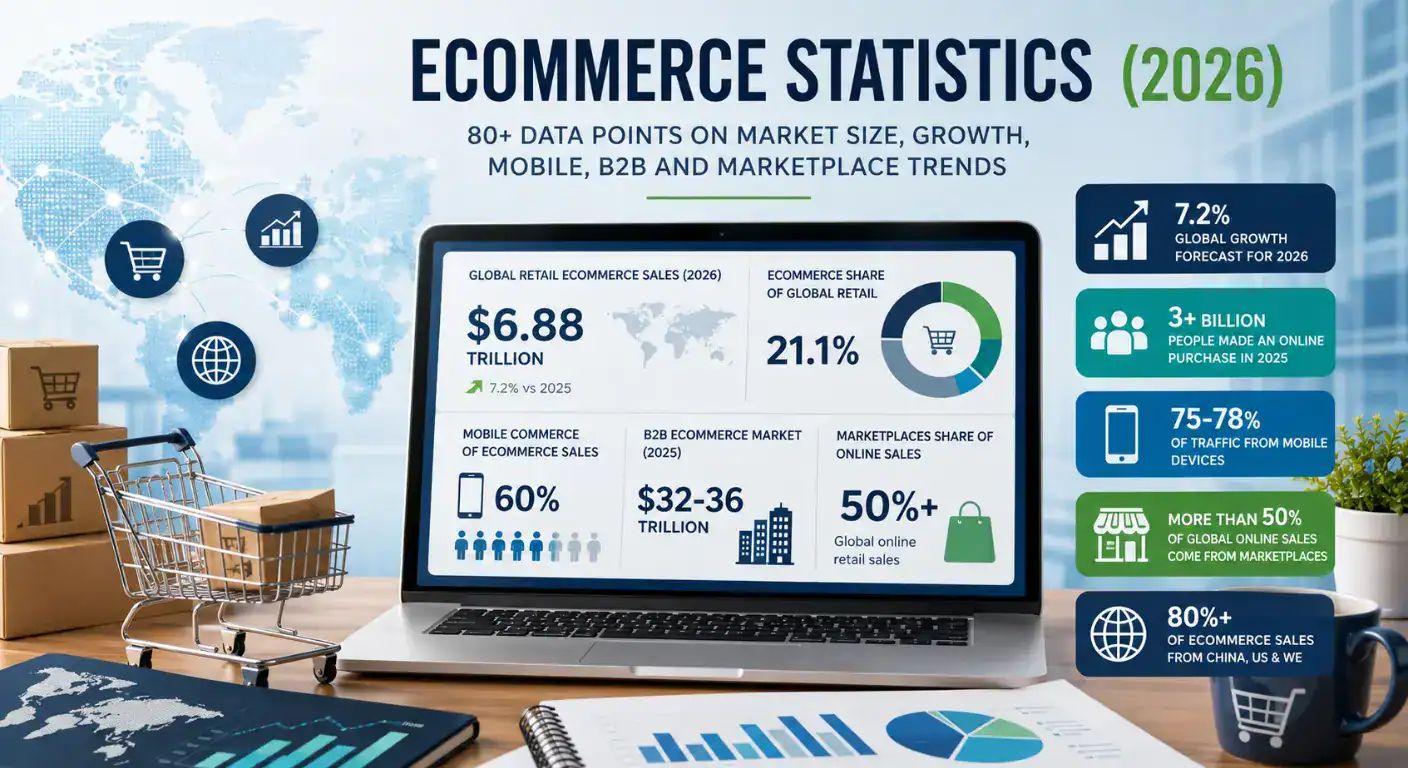
Continue reading -> Continue reading →All statistics are sourced from publicly available research reports including Shopify Commerce Trends, Statista, eMarketer, Eurostat, EuroCommerce European E-commerce Report 2025, Capital One Shopping Research, Mordor Intelligence, and other cited sources. Data reflects the most recent available figures as of mid-2026.
| TL;DR Global retail ecommerce sales are forecast to reach USD 6.88 trillion in 2026, representing 21.1% of total global retail. European B2C ecommerce reached EUR 842 billion in 2024, growing 7% year-on-year, with the Netherlands, Germany, and France as the largest national markets after the UK. Mobile commerce now accounts for approximately 60% of global ecommerce sales – smartphones generate 75-78% of traffic but still convert at roughly half the rate of desktop. B2B ecommerce is 5-6x larger than B2C by total transaction value, with the global B2B market estimated at USD 32-36 trillion in 2025. Marketplace platforms now account for more than half of all global online retail sales, with Amazon, Alibaba, and Pinduoduo collectively representing 45-55% of global marketplace GMV. |
The ecommerce industry generates more data than almost any other sector – and most of it is contradictory, depending on how the source defines ecommerce (B2C only vs. B2B and C2C included; products only vs. services; retail only vs. all digital commerce). Understanding what the numbers actually measure matters before you use them for planning or comparison.
This article presents 80+ ecommerce statistics for 2026, clearly attributed to their source and scope. The figures are organised by theme: global market size, regional breakdown, growth trends, cross-border commerce, mobile, B2B, marketplace data, shopping behaviour, and future trends. Each section opens with the most frequently cited headline number, followed by the supporting data that provides context.
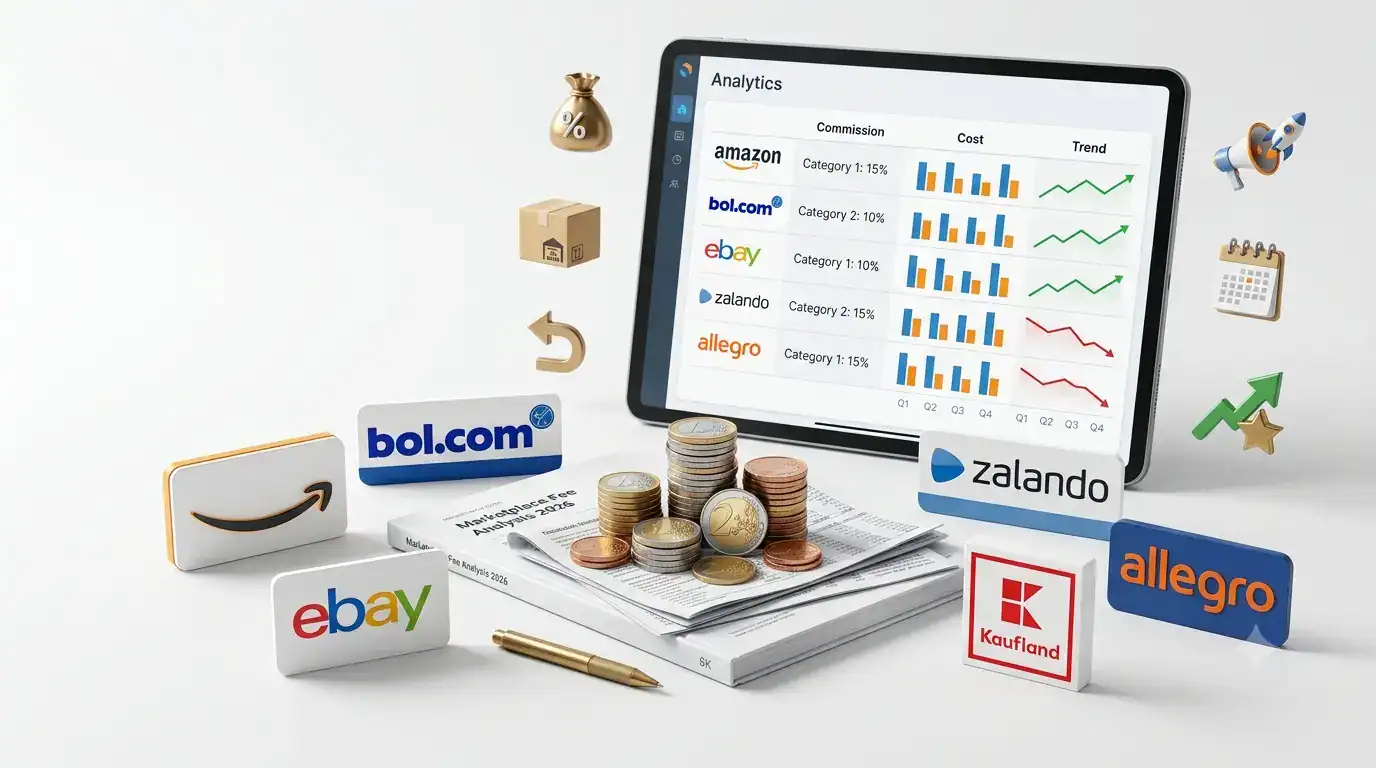
Continue reading -> Continue reading →This comparison is based on publicly available fee schedules, official marketplace documentation, and verified third-party sources as of mid-2026. Fees change regularly. Always verify against your platform’s seller portal before making pricing decisions.
| TL;DR Commission fees across major European marketplaces range from 5% to 25% of the selling price, depending on category and platform. Amazon reduced its EU referral fees in early 2026 by an average of EUR 0.17 per unit, one of its largest-ever European fee cuts. Clothing now starts at 5% for items under EUR 15. bol.com charges no monthly seller fee: you pay commission only when you sell. Rates run from 5% to 17% plus a fixed amount per transaction. Zalando’s total selling cost is the highest of any platform reviewed here: commission of 8-25% plus a monthly fee of EUR 40, and additional marketing spend that partners call effectively mandatory for visibility. The headline commission rate is never the full cost. FBA fulfillment, return processing, advertising, and monthly fees routinely add 10-20 percentage points to your effective cost per sale. |
Marketplace fees are one of the most researched topics in e-commerce, and one of the most misunderstood. Most guides compare headline commission rates as if they were the only cost. In practice, the commission is one line in a fee stack that can include monthly seller fees, fulfillment costs, return processing fees, advertising spend, and payment processing charges.
This comparison covers the six most relevant marketplaces for European merchants: Amazon, bol.com, eBay, Zalando, Allegro, and Kaufland, with current 2026 rates, the hidden costs that rarely appear in overview tables, and a realistic total-cost model for a sample product to show what you actually pay per sale.
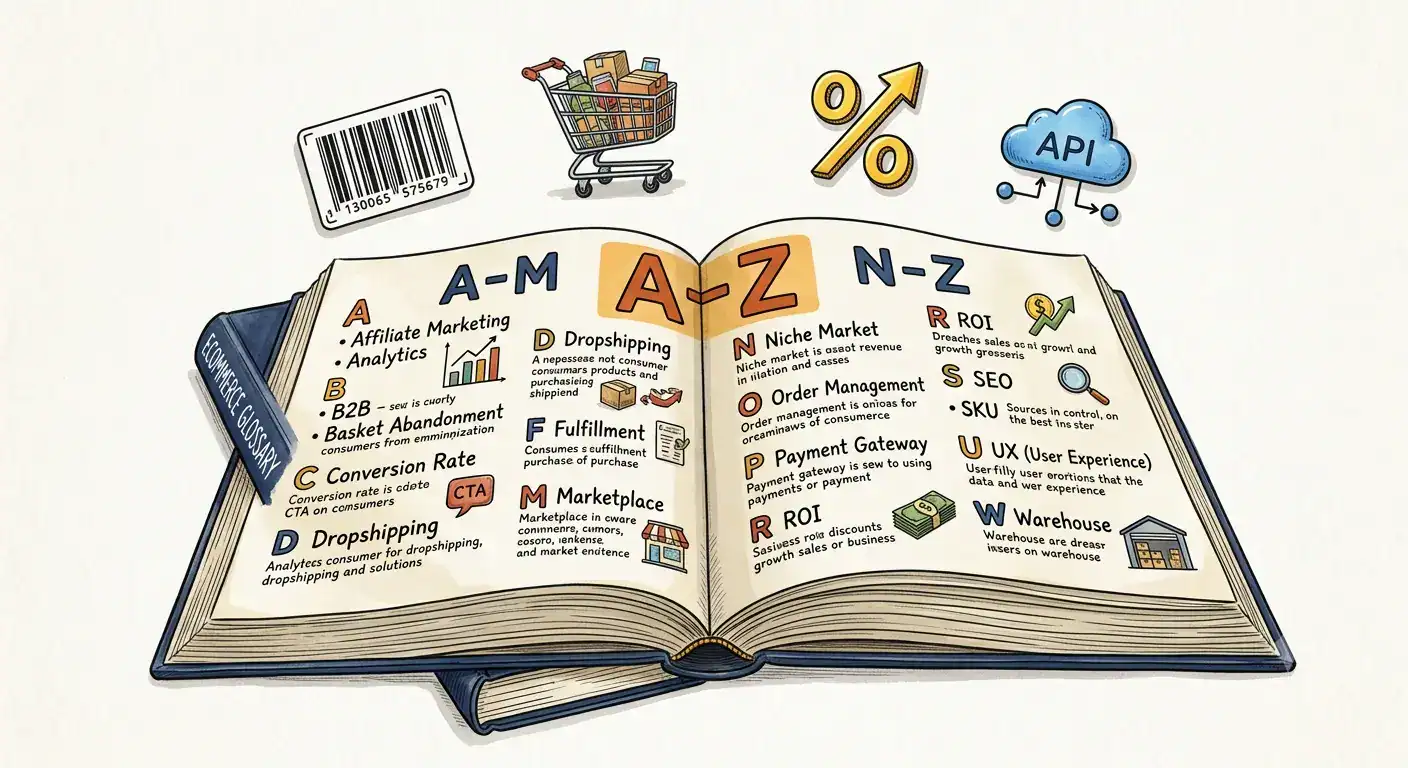
Continue reading -> Continue reading →An ecommerce glossary is a reference library of terms used across online retail – covering advertising metrics, technical integrations, operational systems, marketplace concepts, and feed management terminology. This glossary is designed for online merchants, ecommerce managers, and digital marketing teams who work with platforms like Shopify, WooCommerce, Amazon, bol.com, and Google Shopping.
Every term in this glossary includes: a clear definition, an AI-optimised summary for quick reference, a concrete ecommerce example, common mistakes to avoid, best practices, and links to related articles and guides.
| TL;DR This glossary covers 35+ essential ecommerce terms with definitions, examples, common mistakes, and best practices – built for online merchants who want to understand the language of multichannel selling. Key terms span product feeds, marketplace integration, advertising metrics (ROAS, CPC, CTR), and operational systems (ERP, PIM, OMS). Each entry includes an AI-ready summary, a concrete ecommerce example, and links to relevant guides. Use the A-Z index below to navigate directly to any term, or scroll through the full glossary alphabetically. |